


If you’ve ever felt a persistent, nagging ache deep in your shoulder, especially one that flares up when you reach overhead, grab something behind your back, or try to sleep on that side, you may be dealing with shoulder impingement syndrome. It’s a common condition I see in my practice. Understanding what’s actually happening inside the joint can make a meaningful difference in how you approach treatment and, ultimately, your recovery.
Key Takeaways
- Shoulder impingement syndrome occurs when the soft tissue structures inside the shoulder, most often the rotator cuff tendons and the bursa, become compressed during arm movement, particularly in the space beneath the acromion.
- The condition can develop gradually from repetitive overhead activity, poor posture, rotator cuff weakness, or structural differences in the anatomy of the shoulder.
- Common symptoms include pain with overhead reaching, weakness, and discomfort when lying on the affected side, especially at night.
- Many cases respond to non-surgical treatment, including physical therapy and activity modification. In some cases, surgery may be considered.
The Anatomy Behind the Problem
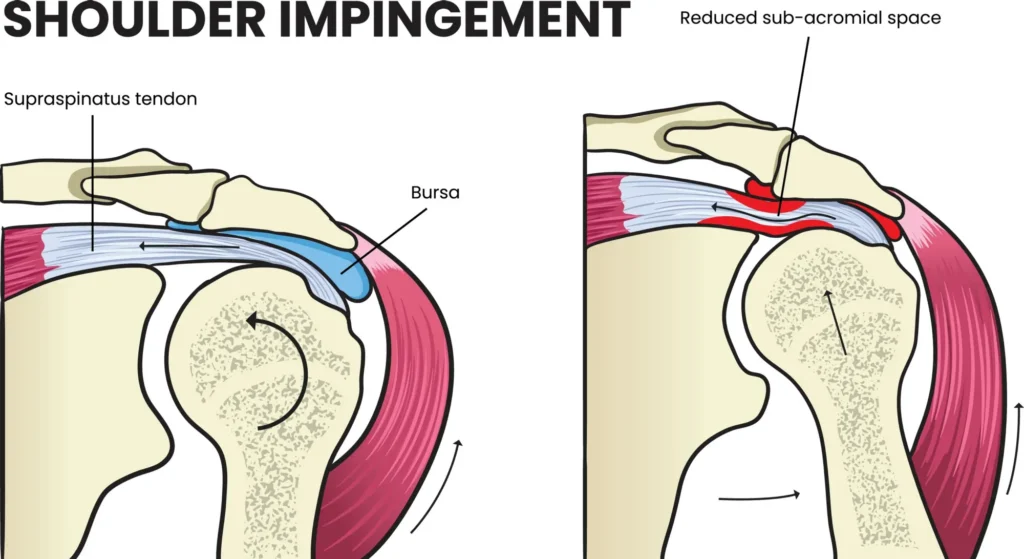
To understand shoulder impingement syndrome, it helps to take a quick look at what’s happening inside your shoulder. The shoulder is a ball-and-socket joint. The rounded head of the upper arm bone, the humerus, fits into the shallow socket of the shoulder blade, called the glenoid. Above this joint sits a flat, bony extension of the shoulder blade called the acromion, which effectively forms the “roof” of the shoulder.
Between the top of the rotator cuff and the underside of the acromion, there is a small area called the subacromial space. This narrow corridor contains the subacromial bursa, a fluid-filled sac that acts as a cushion, along with the tendons of the rotator cuff. When everything is working well, the rotator cuff keeps the ball of the shoulder properly centered in the socket, and the tendons glide smoothly through this space without friction or pressure.
The problem starts when that space becomes too narrow. When the gap between the rotator cuff tendons and the acromion shrinks, the structures inside can get pinched, or “impinged,” during movement.
What Is Shoulder Impingement Syndrome?
Shoulder impingement syndrome is a condition in which the soft tissue structures inside the subacromial space become compressed or irritated during arm movement. This compression tends to be most noticeable when you raise your arm out to the side or forward, roughly between 60 and 120 degrees of elevation. Orthopedic surgeons sometimes refer to this painful range as the “painful arc.” You lift your arm, hit that window of motion, feel a sharp or aching pain, and then, interestingly, the pain may actually ease as the arm continues higher.
The repeated friction and pressure can trigger inflammation. Over time, if symptoms persist without appropriate management, the bursa may become more inflamed, and the rotator cuff tendons may develop degenerative changes or partial tearing.
It’s also helpful to know that there are two broad types of impingement:
- Primary impingement is associated with the structural narrowing of the subacromial space itself. This can result from bone spurs on the underside of the acromion, an acromion that is naturally curved or hooked in shape, or changes in the AC joint that reduce available room. These anatomical factors can be present from birth or develop gradually over time.
- Secondary impingement is driven by functional problems rather than structural ones. Weakness or imbalance in the rotator cuff muscles, poor control of the shoulder blade, or tightness in the surrounding muscles can change how the shoulder moves. When these muscles are not functioning optimally, the humeral head may shift upward in the socket, which can contribute to reduced subacromial space during movement.
Common Causes and Risk Factors
Shoulder impingement syndrome rarely develops overnight. It tends to build up gradually, driven by a combination of activity patterns and individual risk factors.
Repetitive overhead activities one of the most common contributors. Athletes who swim, throw, or play tennis are particularly susceptible, given the repeated demands placed on the shoulder. But overhead strain isn’t exclusive to sports. Painters, electricians, plumbers, and construction workers who frequently work with their arms elevated can develop the same pattern of irritation over time.
Poor posture plays a larger role than many people realize. When we slouch, rounding the upper back and allowing the shoulders to roll forward, it changes the position of the shoulder blade. That shift can reduce the subacromial space and increase the likelihood of impingement, even in the absence of obvious overuse.
Rotator cuff weakness or imbalance is another factor. When the rotator cuff isn’t strong or coordinated enough to keep the humeral head properly centered during movement, extra stress falls on the surrounding structures and the subacromial space narrows under load.
Beyond these contributors, several other factors may raise your risk:
- A naturally hooked or curved acromion shape (a Type II or Type III acromion)
- Bone spurs beneath the acromion or around the AC joint
- A history of shoulder injuries or prior rotator cuff problems
- Advancing age, as tendon tissue tends to become less resilient over time
- Occupations or sports that involve frequent, repetitive overhead work
Recognizing the Symptoms
Pain is typically the first and most prominent complaint. It most often presents as a dull, aching discomfort in the front or outer side of the shoulder, frequently radiating down the upper arm. The pain usually intensifies when lifting the arm out to the side or reaching overhead, and it tends to be most noticeable in that mid-range of motion we discussed earlier.
Activities like reaching behind the back can also reproduce the discomfort. Nighttime pain is a very common complaint with shoulder impingement syndrome and is worth mentioning to your doctor. Many patients find that lying on the affected shoulder becomes genuinely difficult, disrupting their sleep and compounding their frustration.
In addition to pain, patients may also notice:
- Weakness in the shoulder, especially during lifting or reaching
- A sense of stiffness or reduced range of motion
- Occasional clicking or catching sensations during shoulder movement
- Difficulty with tasks that require raising the arm above shoulder height
It’s worth emphasizing that these symptoms can look quite similar to those of a rotator cuff tear or shoulder bursitis. This is one reason why imaging and a thorough hands-on exam are so valuable in arriving at the right diagnosis.
How Is It Diagnosed?
When a patient comes to me with these types of complaints, the process typically starts with a detailed history and physical examination. I’ll ask about when the pain started, which activities make it worse, whether any specific event preceded the symptoms, and what your daily demands look like at work and during physical activity. During the physical exam, I’ll assess your shoulder’s range of motion, strength, and pain pattern.
Imaging commonly plays an important supporting role. X-rays can reveal bone spurs, changes in the shape of the acromion, or narrowing of the subacromial space. An MRI may be ordered to evaluate the soft tissue structures in more detail, including the rotator cuff tendons and the bursa. This helps rule out a significant tendon tear and provides a clearer picture of any inflammation or degenerative changes that may be present.
Treatment Options for Shoulder Impingement Syndrome
The encouraging news is that shoulder impingement syndrome responds well to treatment in most cases. For the majority of patients, non-surgical approaches are the appropriate starting point. An experienced shoulder specialist can help guide the most appropriate treatment approach for you.
Non-Surgical Treatment
Activity modification is usually one of the first practical steps. Reducing or temporarily avoiding the specific activities that aggravate your symptoms can give the irritated tissues an opportunity to calm down. This doesn’t mean stopping all movement; in fact, staying gently active is generally encouraged.
Physical therapy is frequently an element of non-surgical care. A skilled physical therapist can work to address the root causes of the impingement, including strengthening the rotator cuff, improving how the shoulder blade moves, and restoring flexibility in tight muscles around the shoulder and chest. Correcting these patterns helps take pressure off the subacromial space and creates the conditions for healing.
Anti-inflammatory medications such as NSAIDs may help reduce pain and swelling in the short term. They address the symptoms rather than the underlying cause, but they can make it easier to participate in physical therapy.
Corticosteroid injections into the subacromial space may provide temporary relief for patients whose pain is severe enough to interfere with sleep or their ability to engage in therapy. The injection reduces inflammation directly at the site of irritation. It isn’t a permanent solution, but it can create a window of reduced pain during which therapeutic exercise becomes more productive.
Surgical Treatment
When conservative treatment fails to provide adequate relief after several months of dedicated, structured effort, surgery may become a reasonable consideration. The most common procedure for shoulder impingement syndrome is called subacromial decompression. It is most often performed arthroscopically, meaning through small incisions with the help of a small camera and specialized instruments.
During the procedure, the surgeon removes bone spurs and, when indicated, reshapes the undersurface of the acromion to create more room for the rotator cuff tendons to move freely. The bursa may also be addressed if it is significantly inflamed or scarred. If a rotator cuff tear is identified during the procedure, it may be repaired at the same time.
Recovery timelines vary, but many patients are able to gradually return to activity over several weeks to months, depending on the extent of the procedure and adherence to rehabilitation.
Summary
When the soft tissue structures in the subacromial space become compressed or irritated during movement, pain and functional limitation tend to follow. Whether the contributing factors involve structural anatomy, repetitive overhead demands, poor posture, or rotator cuff weakness, an accurate diagnosis is the first step toward meaningful improvement. Many patients respond well to non-surgical treatment. For those who need additional intervention, surgical options may be discussed.
Frequently Asked Questions
Can shoulder impingement syndrome go away on its own?
In some mild cases, symptoms may improve with rest and activity modification alone. However, if the underlying cause is not addressed, the condition may return or gradually worsen. Many patients may benefit from a structured physical therapy program that targets the contributing factors rather than just the symptoms.
How long does recovery from shoulder impingement syndrome typically take?
Recovery time varies depending on how long the condition has been present and how it is being treated. Many patients experience significant improvement within weeks to months. More chronic or severe cases may take longer to fully resolve, and maintaining the habits developed in therapy can help prevent recurrence.
Is it safe to keep exercising with shoulder impingement syndrome?
It depends on the specific activity. Many forms of exercise can be continued or adjusted to avoid provoking the shoulder, and staying active is generally beneficial. Working with a physical therapist can help you identify which movements are safe and which should be temporarily modified. High-impact or repetitive overhead activities are typically the most problematic and may need to be limited while healing is underway.
