


Medically reviewed by James Andry, MD | Reviewed May 2026
“How long does recovery from elbow surgery take?” is one of the questions I get asked most. How quickly someone recovers depends heavily on what was actually wrong, what we did to fix it, and how seriously they take rehabilitation afterward. A patient who had a small tendon debridement is not on the same timeline as someone who had a fracture repaired or a ligament reconstructed.
What I try to give every patient before surgery is an honest, procedure-specific picture of what recovery actually looks like. Not a best-case estimate, not a worst-case warning, but a realistic map of the phases they’ll move through and what factors will affect their pace. This post does that for the elbow surgeries I perform most commonly in my San Diego practice.
Key Takeaways
- Recovery timelines vary significantly depending on the procedure. Minor tendon surgery may allow a return to activity within weeks, while ligament reconstruction or fracture repair typically requires several months.
- The elbow is particularly prone to post-surgical stiffness, which makes early, guided range-of-motion work more important here than for almost any other joint.
- Most elbow surgeries are done arthroscopically or through small incisions, which reduces soft tissue disruption, but the internal healing of tendons, ligaments, and bone still follows its own biology regardless of incision size.
Why Elbow Recovery Is Different from Other Joints
The elbow has less inherent tolerance for immobilization than almost any other joint in the body. Stiffen a knee for six weeks and you’ll spend six weeks getting motion back. Stiffen an elbow for six weeks and you may spend six months trying to fully recover what was lost. The joint capsule contracts quickly, the surrounding soft tissues tighten, and heterotopic ossification (abnormal bone formation in the soft tissue around the joint) can develop when the elbow is held still too long after trauma or surgery.
This is why, for most elbow procedures, I prioritize getting motion started early, not aggressively, but deliberately. The goal in the first weeks is usually not strength. It’s keeping the joint mobile while the repair underneath heals. Those are sometimes competing demands, and managing that tension is what good elbow rehab is about.
The other thing that distinguishes elbow recovery is the ulnar nerve. It runs along the inner side of the elbow in a confined channel, and it doesn’t like swelling, traction, or prolonged pressure. After elbow surgery, tingling or numbness in the ring and small fingers is not uncommon in the early weeks. It usually resolves as swelling settles, but it’s something I always discuss with patients beforehand so they’re not alarmed when they feel it.
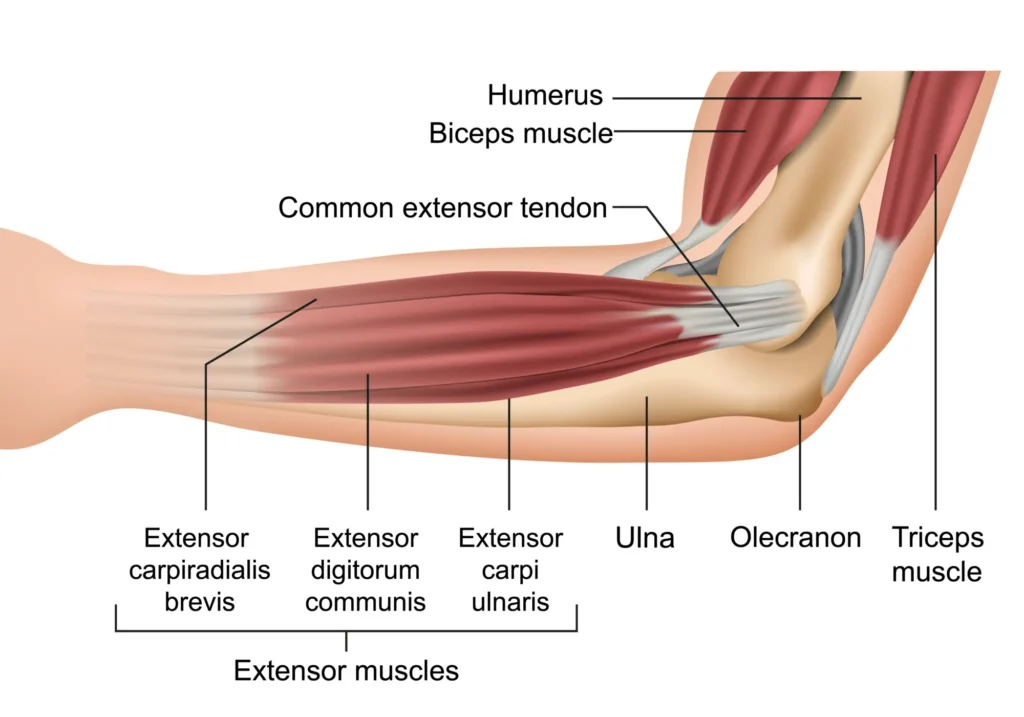
Tennis Elbow and Golfer’s Elbow Release
Surgical release for lateral epicondylitis (tennis elbow) or medial epicondylitis (golfer’s elbow) is generally the least intensive recovery among elbow procedures. The surgery removes degenerated tendon tissue and, in some cases, releases the tendon from the bone to relieve the chronic tension that’s driving pain. Most of these are done arthroscopically or through a small incision, with minimal disruption to the surrounding structures.
Gentle range-of-motion begins almost immediately. Most people are comfortable with light daily activities within two to four weeks. The longer phase is returning to the activities that caused the problem in the first place (gripping, lifting, repetitive wrist motion) and that usually takes three to four months of progressive rehabilitation.
The thing I emphasize with these patients: this surgery addresses the damaged tissue, but it doesn’t change the mechanics that caused the damage. If someone returns to the exact same training load, grip patterns, or work habits without modification, the tendon can break down again.
Cubital Tunnel Release
Cubital tunnel surgery addresses compression of the ulnar nerve as it passes around the inner elbow. When the nerve is compressed long enough, patients develop numbness and tingling in the ring and small fingers, weakness in the hand, and sometimes a clawing posture in those fingers during gripping. The surgery decompresses the nerve and, in some cases, moves it to a new position where it’s less exposed to tension with elbow movement.
Recovery from a simple release is generally straightforward. Most patients are in a soft splint for a week or two, with progressive return to normal activity over four to six weeks. The nerve itself, though, is a slower story. Nerve healing is measured in millimeters per day, and if the compression was significant or longstanding, full recovery of sensation and strength in the hand can take six months to a year. I always tell patients the surgery stops the damage; it doesn’t instantly reverse it.
Distal Biceps Tendon Repair
Distal biceps repair is one of the more time-sensitive elbow surgeries in terms of when it’s done, and the recovery is more structured than patients typically expect.
The elbow is placed in a protective brace after surgery, with motion introduced gradually over the first several weeks. The tendon is reattaching to bone during this time, and the early range-of-motion work has to be enough to prevent stiffness without being so aggressive that it compromises the repair. Strengthening, especially the supination (palm-up rotation) that the distal biceps primarily powers, comes later, typically around the three-month mark. Return to heavy lifting or manual labor usually takes four to six months.
UCL Reconstruction (Tommy John Surgery)
Ulnar collateral ligament reconstruction is most common in overhead throwing athletes (baseball pitchers, quarterbacks, javelin throwers), though I see it in recreational athletes and laborers as well. It’s one of the longer recoveries among elbow procedures, and I think it’s important to say that directly rather than let patients discover it three months post-op. The graft, typically taken from the patient’s own forearm or elsewhere, needs time to incorporate and mature before it can handle the forces of throwing. That process has a floor that can’t really be accelerated.
The general milestones are: protected range-of-motion in the first several weeks, progressive strengthening from two to four months, light throwing beginning around four to six months (for athletes), and return to competitive throwing or full overhead sport at twelve months or beyond. I tell throwing athletes to plan for a year. Some get there faster; some take longer. But planning for twelve months and being pleasantly surprised is better than planning for eight and being frustrated.
Elbow Fracture Repair
Fractures around the elbow are among the more complex recoveries I manage. The elbow doesn’t tolerate prolonged immobilization after fracture, which means I’m often trying to get motion started earlier than the bone would prefer, while still giving the fixation time to hold. That balance is more delicate than with soft-tissue surgery.
Timelines depend heavily on the fracture pattern, the fixation used, and the patient’s bone quality. Simple olecranon fractures fixed with a plate and screws may allow early flexion-extension exercises within a week or two, with return to light activity at six to eight weeks and full activity at three to four months. Distal humerus fractures tend to be more involved, and recovery can extend to six months or beyond. Some complex fractures ultimately require elbow replacement rather than fixation, which carries its own distinct recovery.
I’m more cautious with my timeline estimates for fractures than for soft-tissue surgery because there are more variables. What I can tell any fracture patient is that we’ll be watching your progress closely and adjusting the plan based on what we see on X-ray and in the clinic, not just based on the calendar.
Elbow Arthroscopy for Arthritis or Loose Bodies
Arthroscopic procedures, removing loose fragments of bone or cartilage, cleaning up arthritic changes, or addressing impingement at the end ranges of motion, generally carry the shortest recovery of any elbow surgery I perform. The joint is accessed through small portals, the procedure is done with the patient asleep but without large incisions, and most patients go home the same day.
Swelling and soreness dominate the first one to two weeks. Range-of-motion exercises begin almost immediately to take advantage of the fact that the joint has been cleaned up and to prevent the scar tissue from re-restricting motion. Many patients are back to light daily activity within two to three weeks and return to heavier use by six to eight weeks, depending on what was found and addressed.
The important caveat: arthroscopy treats the mechanical problem but doesn’t reverse the underlying arthritis. If someone has significant joint degeneration, the procedure may buy meaningful time and comfort, but it’s a conversation I have before surgery so patients have accurate expectations about what the outcome realistically is.
What I See in My Patients
The patients who recover fastest share a few traits: they start moving early but on schedule, they show up to physical therapy, and they ask questions instead of either ignoring problems or panicking. San Diego has a large athletic population, and many of my patients are used to pushing through discomfort in training. Post-elbow-surgery, that instinct can work against you. The most common avoidable setback is adding load too early because the pain has resolved and they feel ready. Pain resolution and tissue healing are not the same event.
The second most common issue is patients who under-mobilize in the first few weeks because they’re worried about disrupting the repair. Stiffness that sets in early is genuinely hard to recover from. If your surgeon or therapist is telling you to start moving the joint, that instruction matters as much as any restriction.
Summary
Elbow surgery recovery rewards patience more than almost any other upper extremity procedure. The joint is unforgiving of shortcuts, but it’s capable of excellent outcomes when the process is followed. Recovery ranges from a few weeks for minor arthroscopic procedures to a year or more for ligament reconstruction in throwing athletes. The specific procedure, the patient’s activity demands, and the quality of rehabilitation all matter more than the surgery itself in determining where on that spectrum any individual lands.
If you’re facing elbow surgery, or trying to make sense of a recovery that isn’t going the way you expected, schedule an appointment. The most useful thing I can do before any procedure is make sure you walk in with an accurate picture of what comes after.
Frequently Asked Questions
How soon can I use my arm after elbow surgery?
It depends on the surgery. After minor arthroscopic procedures or tendon debridement, light daily use including eating, typing, and reaching often returns within one to two weeks. After ligament reconstruction or fracture repair, the arm may be in a brace for several weeks before active use is permitted. I give every patient a clear picture of what this means for their specific procedure and timeline before they leave after surgery.
Can I go back to work after elbow surgery?
Desk work and sedentary jobs are often possible within a week or two for most elbow procedures, once pain is controlled. Jobs that require gripping, lifting, or repetitive arm use take longer. If your job involves overhead throwing or very heavy manual labor, the conversation is closer to the athletic return-to-sport discussion, and I’d plan conservatively.
What are the signs that there is a problem with my elbow recovery?
Though they don’t always signal a problem, signs always worth a call to my office include increasing rather than decreasing pain after the first week or two, significant swelling that isn’t improving, new or worsening numbness or tingling in the fingers, and any wound changes like increasing redness, warmth, or drainage. Stiffness that isn’t responding to therapy is also worth flagging early, since it’s much easier to address at six weeks than at six months. Don’t wait for your next scheduled appointment if something feels wrong. Reach out directly.
