


Medically reviewed by James Andry, MD | Reviewed August 2026
Is shoulder arthroscopy right for you? The answer depends on what’s causing your shoulder pain. When I evaluate a patient, my goal is to determine whether a minimally invasive procedure like shoulder arthroscopy is likely to provide meaningful benefit or whether another treatment is more appropriate. In this post, I’ll explain what shoulder arthroscopy is, when I recommend it in my San Diego clinic, and what patients can expect.
Key Takeaways
- Shoulder arthroscopy is a minimally invasive technique that uses a small camera and instruments through tiny incisions, rather than one large surgery, to diagnose and treat problems inside the joint.
- It’s used to treat a wide range of shoulder conditions, including rotator cuff tears, labral tears, instability, and impingement, though the right candidates and the right procedure vary by condition.
- Whether arthroscopy is right for you depends on your diagnosis, how long you’ve tried non-surgical treatment, and your activity goals, not simply on wanting to avoid a bigger incision.
What Is Shoulder Arthroscopy?
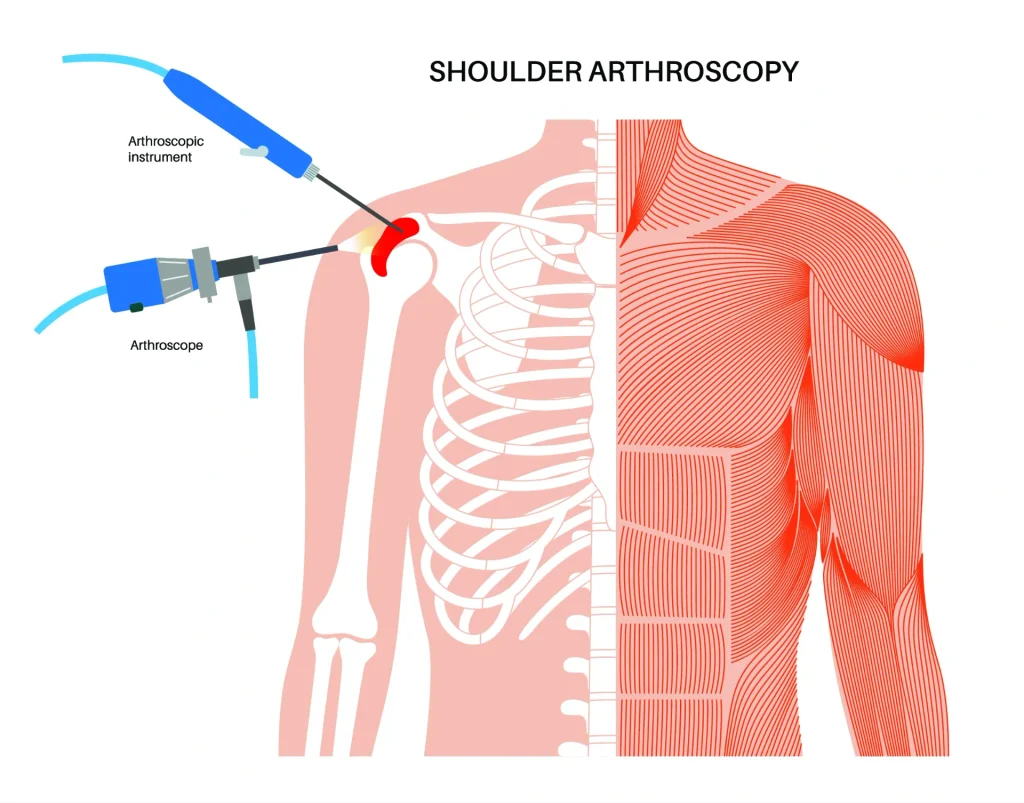
Shoulder arthroscopy is a surgical technique, not a single procedure. During arthroscopy, a surgeon makes a few small incisions around the shoulder, roughly the size of a buttonhole, and inserts a narrow camera called an arthroscope into the joint. The camera sends a magnified image to a monitor in the operating room, giving a detailed view of the structures inside, including the labrum, rotator cuff, biceps tendon, and joint capsule.
Specialized instruments are passed through the other small incisions to repair torn tissue, remove damaged fragments, or reshape bone, all without the larger incision that traditional open surgery requires. Because the surrounding muscle isn’t cut or detached the way it often is in open procedures, patients typically experience less post-operative pain and a shorter path back to motion, though recovery still takes real time and commitment.
Conditions I Treat With Arthroscopy
Arthroscopy isn’t a treatment for one specific injury. It’s a way of accessing the joint that I apply differently depending on what’s actually wrong.
Rotator Cuff Tears
When a rotator cuff tear doesn’t respond to therapy, medication, or injections, arthroscopic repair allows the torn tendon to be reattached to the bone using anchors and sutures, all through small portals rather than a large open incision.
Labral Tears and Shoulder Instability
For patients with a torn labrum or recurrent instability, arthroscopy allows me to repair the torn cartilage and tighten the surrounding capsule to restore stability. I’ve written in more detail about shoulder instability symptoms and what tends to drive that pattern.
Shoulder Impingement and Biceps Tendon Problems
When impingement or biceps tendon irritation doesn’t improve with conservative care, arthroscopic procedures such as subacromial decompression or biceps tenodesis may help relieve the pinching and address the damaged tendon.
Frozen Shoulder
In select cases of adhesive capsulitis that don’t respond to therapy and injections, an arthroscopic capsular release aims to restore motion by addressing the tightened joint capsule directly.
What Happens During the Procedure
Most shoulder arthroscopy is performed on an outpatient basis, meaning patients go home the same day. The procedure is typically done under a combination of regional nerve block and general anesthesia, which helps manage pain both during and immediately after surgery. Sterile fluid is used to expand the joint space slightly, giving a clearer view through the camera and more room to work with instruments.
The exact steps depend entirely on what’s being treated. A diagnostic arthroscopy alone, done purely to evaluate the joint, may take well under an hour. A combined labral and rotator cuff repair takes longer and involves more instrumentation. I always discuss the specific plan with patients beforehand, along with what I might find and adjust for once I’m inside the joint.
Benefits and Limitations to Consider
Compared with open surgery, arthroscopy generally involves smaller scars, less disruption to the muscle around the joint, and, for many patients, a somewhat more comfortable early recovery. Those advantages are real, and they’re part of why arthroscopic techniques have become the standard approach for so many shoulder conditions.
Some complex reconstructions, especially those involving significant bone loss or very large tears, may still be better suited to an open approach. Part of my job during your evaluation is being honest with you about which category your shoulder falls into.
Most patients go home the same day with a sling, a short course of pain medication, and specific instructions on icing and positioning for the first week. Regional nerve blocks used during surgery often keep the shoulder numb for a number of hours afterward, which helps get ahead of pain before it sets in.
What I See in My Patients
A lot of my arthroscopy patients in San Diego and Carlsbad come in having already tried months of physical therapy, injections, or simply pushing through the pain. I also see patients who wait so long that a repairable tear becomes a harder one, or a shoulder that could have stabilized with a straightforward procedure develops more bone loss in the meantime.
My honest opinion, shaped by a lot of these conversations: arthroscopy earns its reputation as a lower-impact option, but it’s still surgery, and the decision to move forward should be based on your diagnosis and goals.
Is Shoulder Arthroscopy Right for You?
Arthroscopy tends to be a strong option when non-surgical treatment, such as therapy, activity modification, or injections, hasn’t adequately relieved symptoms, or when imaging shows a structural problem, like a torn labrum or a significant rotator cuff tear, that isn’t likely to improve without repair. Active patients hoping to return to sports, work, or daily activities without ongoing limitation are often good candidates, as are patients with recurrent instability.
It isn’t automatically the right choice for everyone. Some conditions, particularly certain patterns of arthritis or very large, chronic tears, may be better addressed with an open procedure or, in some cases, joint replacement. Age, activity level, tear size, and how long symptoms have been present all factor into that decision, which is why an individualized evaluation matters more than a general rule of thumb.
My Approach to Treatment
I don’t default to surgery, even arthroscopy, in most cases. I start many patients with a genuine trial of non-surgical care unless there’s a clear reason to move faster, such as a large, acute rotator cuff tear or recurrent dislocations in a young, active patient. When conservative treatment isn’t getting the job done, or when imaging shows damage that physical therapy simply can’t fix, I’ll walk through exactly what an arthroscopic approach would involve for that specific diagnosis, what recovery looks like, and what outcome is realistic.
Recovery after arthroscopy follows a structured, staged rehabilitation plan tailored to the specific repair performed, generally moving from protecting the joint, to restoring motion, to rebuilding strength. You can review the general shape of these plans in my shoulder rehab protocols, though your surgeon and physical therapist will set the specific pace for your procedure.
Summary
Shoulder arthroscopy is a minimally invasive way to diagnose and treat a wide range of shoulder problems, from rotator cuff tears to instability to impingement, using small incisions and a camera instead of a large open incision. Whether it’s right for you depends on your specific diagnosis, how you’ve responded to non-surgical treatment so far, and your goals for returning to activity. If you’ve been managing shoulder pain or weakness for a while without real improvement, the next step is to get a clear diagnosis.
Bring your imaging and history in for an evaluation, and let’s figure out together whether shoulder arthroscopy makes sense for your shoulder specifically. You can request an appointment here to get started.
Frequently Asked Questions
How long does recovery from shoulder arthroscopy take?
It depends heavily on what was repaired. A diagnostic arthroscopy alone may allow a fairly quick return to light activity, while a rotator cuff or labral repair typically involves several months of structured rehabilitation before a full return to sports or heavy activity.
Is shoulder arthroscopy painful?
Most patients experience some pain in the first days after surgery, though it’s generally more manageable than after open surgery because less muscle tissue is disturbed. Pain is typically well controlled with medication and improves steadily over the first couple of weeks.
Will I need physical therapy after arthroscopy?
In most cases, yes. Physical therapy is a central part of recovery, helping restore motion, rebuild strength, and protect the repair as it heals. Skipping or rushing therapy is one of the more common reasons results fall short of expectations.
Can arthroscopy fix every shoulder problem?
No. While arthroscopy addresses a wide range of conditions, some situations, such as advanced arthritis or very large, chronic tears, may be better suited to a different surgical approach. An individualized evaluation helps determine the most appropriate treatment for your specific shoulder.
