


Medically reviewed by James Andry, MD | Reviewed August 2026
By the time a patient sits down in my office ready to talk about shoulder impingement surgery, they’ve usually already tried the therapy, the injections, and the modified activity, and the pain is still there every time they reach overhead. At that point, the conversation shifts from whether surgery might help to what the surgery and the recovery actually involve. I want to walk through what shoulder impingement surgery entails, when I recommend it, and what the recovery timeline realistically looks like, because I’ve found that patients do better when they know what to expect going in.
Key Takeaways
- Shoulder impingement surgery is generally considered only after a genuine trial of physical therapy, activity modification, and injections hasn’t provided lasting relief.
- The most common surgical approach is arthroscopic subacromial decompression, sometimes paired with biceps tenodesis if the biceps tendon is also involved.
- Recovery is a staged process, moving from sling use and pain control, to restoring motion, to rebuilding strength, and it typically takes several months before a full return to overhead activity.
What Shoulder Impingement Surgery Involves
Shoulder impingement happens when the rotator cuff tendons get pinched beneath the acromion, the bony ledge at the top of the shoulder blade, during overhead movement. When conservative treatment doesn’t relieve that pinching, surgery aims to create more room in that space so the tendons can move freely again.
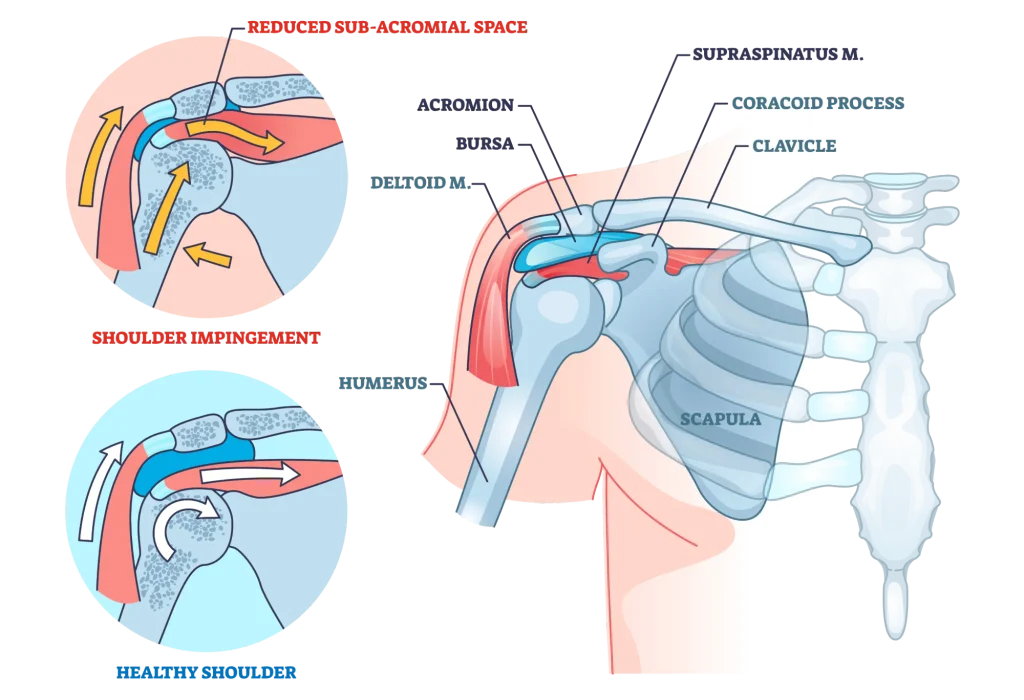
The most common procedure I perform for this is an arthroscopic subacromial decompression, sometimes called an acromioplasty. Working through small incisions with a camera and specialized instruments, I remove inflamed bursal tissue and shave down a portion of the underside of the acromion, widening the space the rotator cuff tendons pass through. If the long head of the biceps tendon is also inflamed or damaged, I’ll often address that at the same time with a biceps tenodesis, reattaching the tendon in a more stable position.
When I Recommend Surgery for Impingement
Surgery isn’t my first move for impingement. Many patients improve with a structured non-surgical program: activity modification, anti-inflammatory medication, physical therapy focused on posture and scapular mechanics, and sometimes a corticosteroid injection to calm things down enough for therapy to work.
I start considering surgery once a patient has given that conservative approach a genuine, months-long effort and the pain is still limiting sleep, work, or the activities they care about. Imaging findings matter too. A bone spur pressing directly on the rotator cuff, or a biceps tendon that’s clearly torn and irritated, tells me conservative care is less likely to fully resolve things on its own.
Confirming the Diagnosis Before Surgery
Before recommending surgery, I want a clear picture of what’s actually happening inside the shoulder, not just a general sense that overhead motion hurts. A physical exam checks range of motion, strength, and specific positions that reproduce the pinching sensation. Imaging typically includes X-rays to look for bone spurs or joint changes, and an MRI to evaluate the rotator cuff tendons, the subacromial bursa, and the biceps tendon in detail.
That combination tells me whether we’re dealing with straightforward impingement, a rotator cuff tear that’s developed alongside it, or a biceps problem that needs its own attention. Surgical planning changes depending on which of those is actually driving the pain, which is part of why I’m cautious about recommending surgery based on symptoms alone. A patient who comes in assuming they need decompression sometimes leaves the consultation with a very different plan once the imaging tells a fuller story.
What I See in My Patients
In my San Diego and Carlsbad practice, a large share of the impingement patients I operate on are people whose work or sport keeps their arms overhead for hours at a time: painters, electricians, swimmers training out of local clubs, and a fair number of recreational golfers and tennis players who kept playing through the pain for a season too long. Overhead demand is a common thread, whether it’s a job site or a serve.
My honest opinion after years of treating this: patients who commit fully to pre-surgical physical therapy, even when it feels slow, tend to have an easier post-operative recovery than those who skipped that step. The shoulder that already knows how to move well before surgery has a real head start afterward.
My Approach to Treatment
When I do recommend surgery, I walk patients through the procedure itself, what I expect to find based on imaging, and what their specific recovery will likely look like given their tissue quality and activity goals. I don’t take a one-size-fits-all approach. A decompression alone carries a different recovery than a decompression combined with a biceps tenodesis, and I make sure patients know which version applies to them before we schedule anything.
Most shoulder impingement surgery is done on an outpatient basis, meaning you go home the same day with a sling and a plan for pain control and icing over the first several days. A regional nerve block is often used alongside general anesthesia, which typically keeps the shoulder comfortably numb for a stretch of time after the procedure, helping you stay ahead of pain before it has a chance to build.
What Recovery Looks Like
Recovery from shoulder impingement surgery follows a staged rehabilitation process, and the specific pace depends on exactly what was repaired. In general, the early phase focuses on protecting the shoulder, controlling pain and swelling, and using the sling as directed while gentle hand, wrist, and elbow motion is encouraged to maintain circulation.
As healing progresses, physical therapy shifts toward restoring range of motion, first passively and then actively, followed by a strengthening phase that rebuilds the rotator cuff and scapular muscles. The final phase focuses on higher-level strength and functional movement, preparing the shoulder for a safe return to work, sports, or overhead activity. Full recovery, including a return to unrestricted overhead activity, generally takes a number of months, and the exact timeline depends on what was done during surgery, how the tissue responds, and how consistently a patient follows through with therapy.
I don’t like giving patients a single number and having them hold me to it, because healing simply doesn’t work that way for everyone. What I can offer is a structured framework, which you can review in general form in my shoulder rehab protocols, with your physical therapist adjusting the pace to how your shoulder is actually responding.
Summary
Shoulder impingement surgery, most often an arthroscopic decompression with or without a biceps tenodesis, is generally reserved for patients who haven’t found lasting relief from physical therapy, activity changes, and injections. Recovery is a staged process that moves from protecting the shoulder, to restoring motion, to rebuilding strength, typically spanning several months before a full return to overhead activity. If you’ve already tried the conservative route and you’re still struggling to reach overhead without pain, the next step is a focused evaluation of your imaging and your history to see whether surgery genuinely makes sense for your shoulder.
Bring your prior treatment history with you, and let’s talk through whether it’s time to move forward or if another treatment is the best next step. You can schedule that evaluation here.
Frequently Asked Questions
How long until I can return to work after impingement surgery?
It depends on the physical demands of your job. Patients with desk jobs frequently return within a couple of weeks in a modified capacity, while those whose work involves heavy lifting or repetitive overhead activity typically need several months before returning without restriction.
Will I need physical therapy after surgery?
Yes, in most cases. Structured physical therapy is central to restoring motion and rebuilding strength safely, and skipping or rushing it is one of the more common reasons recovery doesn’t go as smoothly as hoped.
Is shoulder impingement surgery a big procedure?
It’s typically performed arthroscopically through small incisions on an outpatient basis, which generally means less tissue disruption and a more comfortable early recovery than a large open surgery, though it’s still a real surgical procedure with a genuine recovery process.
Can impingement come back after surgery?
Recurrence is uncommon when the underlying cause has been properly addressed and rehabilitation is completed, though ongoing overhead strain or a missed contributing factor, such as an untreated biceps issue, can occasionally lead to persistent or returning symptoms.
