

Medically reviewed by James Andry, MD | Reviewed June 2026
Most of my patients have already tried rest, bracing, and physical therapy before they end up in my office asking, “What is tennis elbow surgery, and do I need it?” By that point, they’ve usually been dealing with pain on the outside of their elbow for months, sometimes longer. They’re tired of not being able to grip a coffee mug in the morning, or getting stopped cold every time they try to play tennis, golf, or even just carry groceries. That’s the point where surgery may become a conversation.
Tennis elbow, or lateral epicondylitis, is one of the most common elbow conditions I treat. Many patients improve without surgery. But for those who don’t, it helps to understand what surgical treatment involves, when it tends to be the right call, and what to expect on the other side of it.
Key Takeaways
- Tennis elbow surgery is typically considered only after months of conservative treatment has failed to bring meaningful relief.
- The procedure involves removing damaged tendon tissue at the lateral epicondyle, sometimes through a minimally invasive arthroscopic approach.
- Most patients can expect a gradual return to full activity over several months with structured rehabilitation after surgery.
What Is Tennis Elbow?
Tennis elbow develops when the tendons that attach the forearm muscles to the lateral epicondyle (the bony bump on the outside of the elbow) become damaged from repetitive stress. Despite the name, only a small fraction of people who develop this condition actually play tennis. Painters, plumbers, carpenters, and office workers who spend long hours at a keyboard can all develop it. The common thread is repetitive gripping, lifting, or wrist extension over time.
At the tissue level, the problem is typically tendinosis rather than classic inflammation. The tendon degenerates as collagen fibers break down and fail to heal properly, which is part of why anti-inflammatory medications don’t always provide lasting relief. The extensor carpi radialis brevis (ECRB) tendon is most often involved, though other extensor tendons can be affected as well.
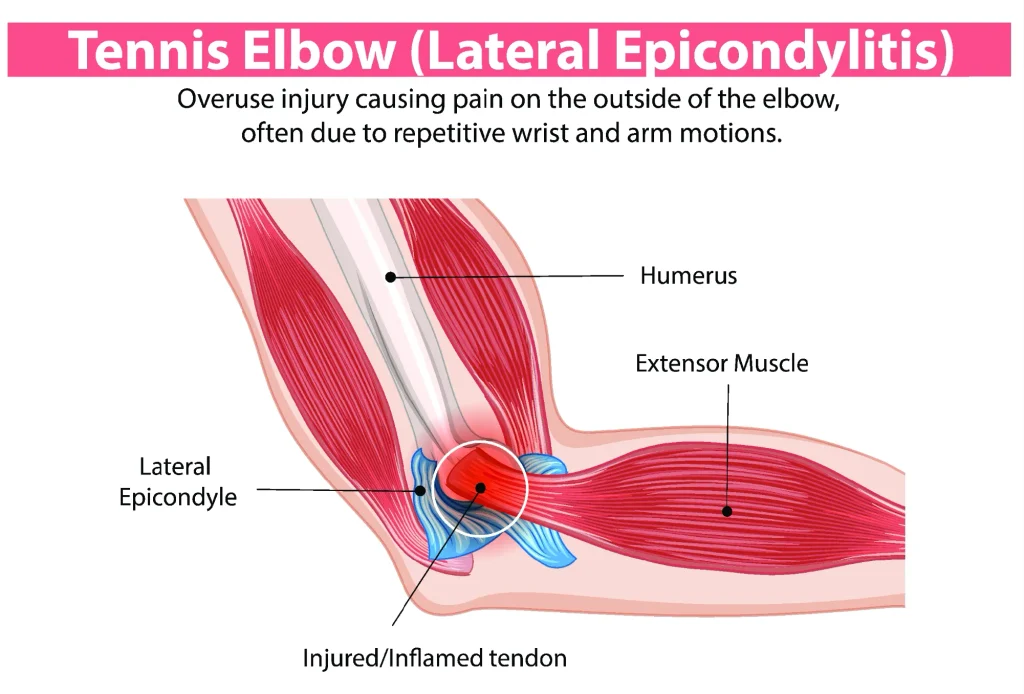
Symptoms of tennis elbow typically include pain and tenderness on the outer elbow, a burning sensation that may run into the forearm, and weakened grip strength. Some patients report that pain is worst with specific movements such as lifting a coffee cup, turning a key, or shaking hands. Others notice that the pain builds gradually through the day. The symptom picture can vary, which is part of why a proper examination matters before assuming surgery is or isn’t the answer.
What I See in My Patients
People don’t usually come in asking for tennis elbow surgery on day one. By the time surgery comes up, they’ve typically worked through several rounds of conservative treatment and found themselves back where they started. What I hear most often is something like: “I did PT for three months, my elbow felt better, and then it came right back as soon as I returned to my normal routine.”
Here in San Diego, a large portion of my elbow patients are active adults: pickleball players, surfers, weekend golfers. The elbow doesn’t always get the attention the shoulder does, but it absorbs a tremendous amount of repetitive stress in those lifestyles.
One thing I’m always assessing is whether the tendon has truly degenerated to the point where it cannot heal on its own, versus a situation where more time and targeted rehabilitation might still turn things around. That distinction matters, and imaging (typically an MRI or diagnostic ultrasound) can be helpful in making it. I’m not in the habit of rushing anyone toward the operating room, but I also don’t think it’s doing a patient any favors to leave them suffering indefinitely when surgery has a good chance of resolving the problem.
When Is Tennis Elbow Surgery Actually Considered?
Surgery is not the first option. It is usually considered after a patient has completed a genuine course of non-surgical care without adequate improvement. That conservative care generally includes activity modification, physical therapy focused on eccentric strengthening, bracing, and sometimes regenerative treatments such as PRP (platelet-rich plasma) therapy.
Steroid injections used to be a standard part of the treatment ladder for lateral epicondylitis. The evidence now tells a different story. Studies have repeatedly shown that while steroid injections may reduce pain at six weeks, outcomes at one year are frequently worse than in patients who did not receive them. That’s why I no longer recommend steroid injections for this condition.
Surgery tends to be a stronger consideration when:
- Pain has persisted for six months or more despite structured conservative treatment.
- Daily function is meaningfully impaired.
- Imaging confirms significant tendon degeneration at the lateral epicondyle.
- The patient has clear activity goals (returning to sport, work, or hobbies) that cannot be met with conservative care alone.
What Tennis Elbow Surgery Involves
The goal of surgery is to remove the degenerated tendon tissue and stimulate the area to encourage new, healthy tissue formation. There are a couple of surgical approaches, and the right one depends on the extent of tendon damage, whether there is suspected joint pathology, and the individual patient’s anatomy.
Arthroscopic Lateral Epicondyle Release
Arthroscopic surgery uses small incisions and a tiny camera to visualize the inside of the joint. Through these small portals, the surgeon removes damaged tissue from the ECRB tendon and can also address any associated joint pathology (such as synovitis or loose bodies) that might be contributing to symptoms.
Open Lateral Epicondyle Release
The open approach uses a small incision directly over the lateral epicondyle to access and remove the damaged tendon tissue.
Both arthroscopic and open techniques have demonstrated good outcomes in the published literature, and the choice between them often comes down to patient health factors, surgeon training, and the degree of tendon involvement. In either case, the procedure is typically performed on an outpatient basis, so most patients go home the same day.
During both approaches, the healthy tendon and surrounding tissue are preserved as much as possible. The bone may be lightly prepared at the attachment site to promote healing. Patients are typically placed in a light splint for a short period after surgery before beginning formal rehabilitation.
My Approach to Tennis Elbow Treatment
When a patient comes in with lateral epicondylitis, I start with a detailed conversation about what they’ve already tried, how long they’ve been dealing with it, and what their functional goals are. That context shapes everything. A 45-year-old pickleball player who wants to compete again is a different situation from someone who simply wants to pour coffee without wincing.
My preference is always to exhaust non-surgical options first. This is not because surgery is a last resort in a negative sense, but because the majority of patients with tennis elbow can and do get better without it. When someone hasn’t yet tried a structured physical therapy program with an eccentric strengthening component, or when they’ve completed one round of treatment and returned to full activity too quickly, there’s still runway left before surgery makes sense.
For patients who have genuinely worked through conservative care and still have significant symptoms, I’ll typically review imaging to assess the degree of tendon degeneration before recommending surgery. If the ECRB shows meaningful pathology and the clinical picture lines up, surgical release and debridement can produce very good outcomes. I prefer the arthroscopic approach in most cases because it gives me a complete picture of what’s happening in the joint.
What to Expect During Recovery
Recovery from tennis elbow surgery is gradual. In the first few weeks, the arm is typically protected and activity is limited. Swelling and soreness are expected, and most patients manage discomfort well with over-the-counter pain relief and ice. Formal physical therapy generally begins within a few weeks of surgery. Early sessions focus on restoring gentle range of motion and preventing stiffness. Strengthening follows as the tendon heals.
Many patients can return to light daily activities within a few weeks of surgery. Return to gripping-intensive work or sport typically takes longer, often three to six months, and sometimes more depending on the demands of the activity and how the tendon heals. The patients who commit to their rehabilitation program and resist the urge to skip ahead tend to do the best. Recovery is not linear, and there will be days that feel like setbacks. That’s normal.
I tell my patients that surgery addresses the structural problem, but the rehabilitation process is what builds the resilience back.
Summary
Tennis elbow is one of the more common conditions I see, and for many people, it resolves without surgery. But for a meaningful subset of patients, surgical release and debridement of the damaged tendon may provide the relief that nothing else has delivered. The decision to pursue surgery should be based on a thorough evaluation, an honest conversation about what conservative care has already been tried, and a clear understanding of what recovery will require.
If you’re in the San Diego area and dealing with chronic lateral elbow pain that hasn’t responded to treatment, I’d encourage you to come in for a consultation. Getting an accurate picture of what’s actually happening in the tendon is the most useful first step. Request an appointment here.
Frequently Asked Questions
How long does recovery from tennis elbow surgery take?
Recovery varies by individual, but most patients can expect a gradual process spanning several months. Light daily activities are often possible within a few weeks. Return to gripping-intensive work or sport commonly takes three to six months, and sometimes longer.
What happens if I don’t get surgery for chronic tennis elbow?
Some patients with chronic tennis elbow continue to manage symptoms without surgery through activity modification, periodic physical therapy, and other conservative measures. For others, ongoing pain significantly limits quality of life and function. Surgery is not mandatory, but for patients whose symptoms are not improving and whose daily activities remain compromised, it may offer a path forward.
Does tennis elbow surgery hurt afterward?
Discomfort after surgery is expected, particularly in the first week or two. Most patients manage post-operative pain well with over-the-counter medications and ice. The level of soreness varies by individual, and your care team will guide you through pain management during recovery.
Can tennis elbow come back after surgery?
Recurrence is uncommon after surgery, but returning to the same repetitive activities without addressing technique or ergonomics may put the tendon at risk again. Rehabilitation after surgery typically includes guidance on gradual return to activity and, where relevant, technique corrections to reduce the likelihood of re-injury over the long term.
