


Medically reviewed by James Andry, MD
Wondering “Why does my shoulder keep dislocating?” One of the first things I explain to patients after a shoulder dislocation is that the initial injury is only part of the story. Once the shoulder has come out of the socket, the risk of it happening again can increase, particularly in younger, more active individuals. In this post, I’ll explain what changes inside the joint after a first dislocation, why some shoulders become unstable while others don’t, and how I decide when surgery is the right next step.
Key Takeaways
- A shoulder that dislocates once is more likely to dislocate again, particularly in younger and more active patients, because the torn tissue rarely heals back to its original strength without help.
- A shoulder that keeps coming out of place is usually being driven by damage to the labrum, a stretched-out joint capsule, or bone loss on the socket or the ball of the joint, not by chance.
- Physical therapy can calm symptoms and build support around the joint, but it cannot reattach a torn labrum or rebuild lost bone.
What Recurrent Shoulder Instability Actually Means
The shoulder is a ball-and-socket joint, but the socket, called the glenoid, is shallow. A ring of cartilage called the labrum deepens that socket, and the joint capsule and ligaments wrap around the outside to hold everything together. When the ball slips fully out of the socket, that is a dislocation. When it slips partway out and slides back on its own, that is a subluxation. Either one can damage the labrum or stretch the capsule, and once that damage is there, the shoulder has less to hold onto the next time it’s stressed.
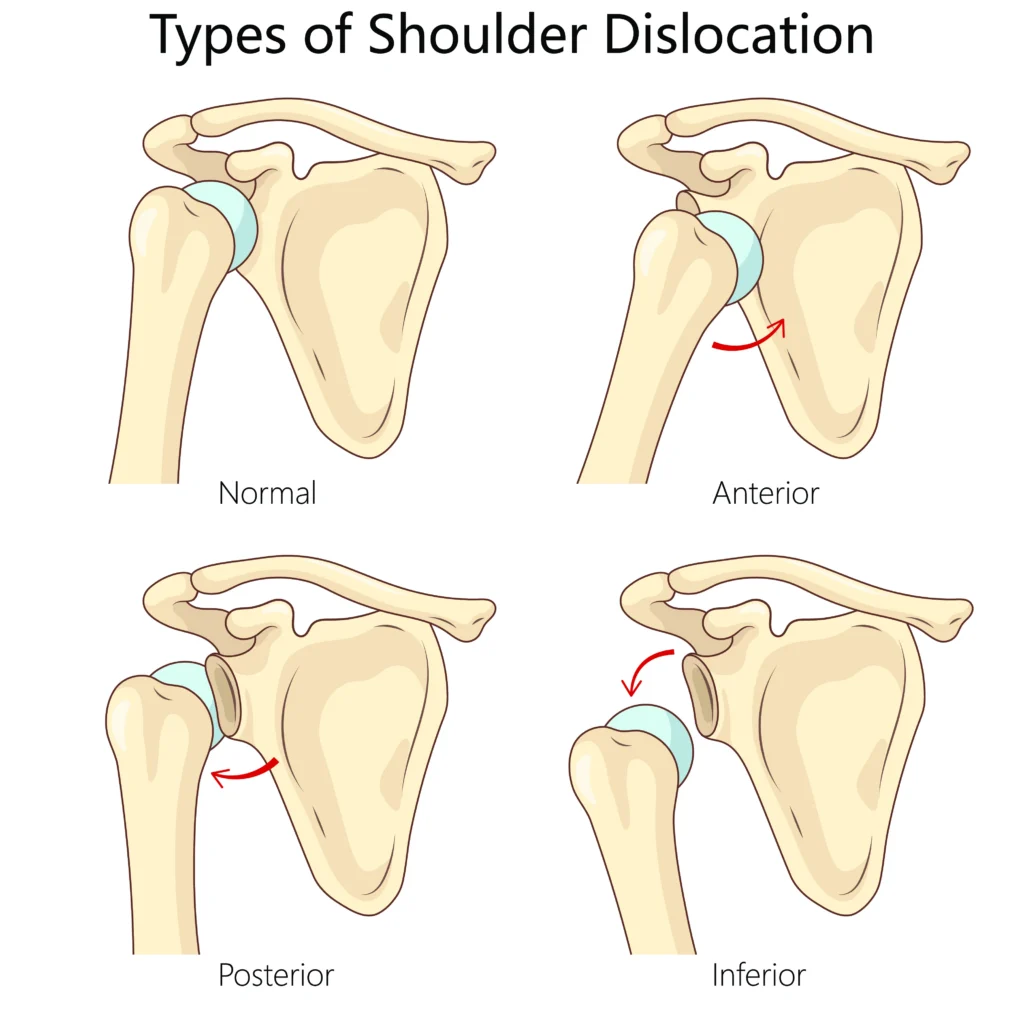
I tell patients that a first dislocation is an event, but a second or third one is a pattern. The pattern matters because it tells me the joint isn’t healing the way it should on its own.
Why the Shoulder Keeps Slipping Out
A handful of things typically explain why a shoulder that’s dislocated once goes on to dislocate again.
A Torn Labrum That Hasn’t Reattached
When the labrum tears away from the socket during a dislocation, it needs to heal back in place to restore the joint’s depth and stability. In a lot of patients, especially younger and more active ones, that tissue heals loosely or doesn’t fully reattach, leaving the socket shallower than it was before the injury.
A Capsule That’s Been Stretched Out
Every dislocation can stretch the ligaments and capsule surrounding the joint a little further. After several episodes, that tissue may become lax enough that it no longer restrains the joint the way it once did, even between episodes.
Bone Loss on the Socket or the Humeral Head
In some patients, repeated dislocations chip away a small amount of bone from the edge of the socket or leave a compression dent on the ball of the joint. When that happens, there’s simply less bony architecture holding the joint in place, which can make future dislocations easier to trigger. I always want imaging before assuming this is or isn’t a factor for a given patient.
In my experience, patients in their teens and twenties who return quickly to sports or heavy activity tend to carry a higher chance of a repeat episode than older, less active patients with the same initial injury.
Recognizing the Pattern
A few signs tend to show up together in patients whose instability has become recurrent rather than a one-time event.
- Dislocations that happen with progressively less force, sometimes just from reaching overhead or rolling over in bed.
- A persistent sense of looseness or slipping even between episodes, not just during an acute dislocation.
- Apprehension in certain arm positions, where the shoulder feels like it’s about to give way even if it doesn’t actually come out.
If you’re still trying to work out whether what you’re feeling counts as instability at all, I’ve written a more general overview of shoulder instability symptoms that may help you sort out what you’re dealing with before we get into treatment.
What I See in My Patients
A good portion of the recurrent dislocators I treat in my Carlsbad and San Diego offices aren’t professional athletes. They’re surfers who keep paddling back out at Cardiff or Tourmaline before the shoulder is ready, jiu-jitsu and grappling athletes training out of the gyms around North County, and a fair number of active-duty and former military patients from the Camp Pendleton and Naval Base San Diego communities whose jobs simply don’t allow for a long break. Their shoulders don’t care about their schedules, and that’s where the trouble starts.
My honest take after years of doing this: waiting through three, four, or five dislocations before seriously considering surgery usually isn’t doing the joint any favors. Every episode is a chance to damage the labrum a little further or chip a little more bone off the socket, and I’d rather have that conversation after the second episode than the sixth.
How I Diagnose Recurrent Instability
Diagnosis starts with a detailed history: how many times has the shoulder come out, what was happening each time, and how much force was involved. A physical exam checks for looseness, apprehension in specific positions, and overall range of motion. From there, imaging fills in the rest of the picture. Plain X-rays can show bone changes or old fractures, while an MRI, sometimes with contrast, gives a much clearer look at the labrum, capsule, and rotator cuff. If I suspect meaningful bone loss, a CT scan may be added to measure it precisely.
My Approach to Treatment
For a first-time dislocation in a patient with no major risk factors, I usually start with a structured course of physical therapy aimed at strengthening the rotator cuff and the muscles around the shoulder blade. Plenty of patients do well with this approach and never have a second episode.
Once instability becomes recurrent, my thinking shifts. Therapy alone can’t reattach a torn labrum or rebuild lost bone, so if a patient has had multiple dislocations, meaningful structural damage on imaging, or a lifestyle where another episode carries real risk, I lean toward arthroscopic stabilization. Through small incisions, I repair the torn labrum and tighten the stretched-out capsule to restore the tension the joint has lost.
After surgery, rehabilitation is structured and gradual, moving from protecting the repair to restoring motion to rebuilding strength. Patients recovering from a stabilization procedure can review the general phases I use in my shoulder rehab protocols.
Reducing Your Risk of Another Episode
Whether or not surgery ends up being part of your plan, a few habits genuinely help protect the shoulder while it heals or while you’re deciding on next steps. A well-designed strengthening program for the rotator cuff and scapular muscles gives the joint dynamic support that ligaments and cartilage alone can’t provide. I also encourage patients to ease back into overhead sports and contact activity gradually rather than jumping straight back to full intensity, since returning too soon after any dislocation is one of the more common ways I see patients re-injure the same shoulder.
None of this guarantees a shoulder won’t dislocate again, and I’m careful not to promise that to anyone. But patients who stay consistent with strengthening and pace their return to activity thoughtfully tend to do better than those who don’t.
Summary
A shoulder that dislocates once can often be managed with therapy and time. A shoulder that keeps coming out of place is usually telling you something structural is going on, whether that’s a torn labrum, a stretched capsule, or bone loss on the socket or humeral head, and it’s worth finding out which before the next episode does more damage. If your shoulder has slipped out of place more than once, or you’re still guarding it months after your last dislocation, the next step is straightforward: get it properly imaged so we can see exactly what’s driving the instability.
If that sounds like where you are, schedule an evaluation at my Carlsbad or San Diego office and let’s take a real look at what’s going on.
Frequently Asked Questions
How many dislocations before surgery is recommended?
There’s no single number that applies to everyone. I generally start considering surgery more seriously after a second dislocation, especially in younger or more active patients, though the decision also depends on imaging findings, activity level, and how much the instability is affecting daily life.
Can a shoulder heal on its own without surgery?
It can, particularly after a first-time dislocation with minimal structural damage. Many patients regain stability with a dedicated physical therapy program. Recurrent instability is less likely to resolve without addressing the underlying labral or capsular damage directly.
Will I lose motion if I have stabilization surgery?
Some tightening of the capsule is the point of the procedure, and a small amount of motion loss is possible, though it’s usually modest and often not noticeable in daily activities. Rehabilitation is designed to restore as much motion as safely possible while protecting the repair.
Is it safe to keep playing sports with a loose shoulder?
It depends on the sport and how unstable the shoulder truly is. Continuing high-risk activity without addressing recurrent instability may increase the chance of further labral or bone damage, so I’d recommend a proper evaluation before deciding to push through it.
