


Medically reviewed by James Andry, MD | Reviewed May 2026
The first thing I ask a patient who comes in with a suspected biceps tendon tear is where they felt it happen. The answer usually tells me most of what I need to know. A pop at the front of the shoulder during overhead work is a different injury, with a different set of options, than a pop in the antecubital fossa when someone tried to curl a loaded barbell or catch themselves from a fall. The biceps muscle has two tendons, one at each end, and what’s right for one may be completely wrong for the other.
I see both injuries regularly in my San Diego practice: the proximal tears more often in middle-aged patients whose long head tendon had been quietly deteriorating for years, and the distal tears more often in active individuals who loaded the muscle the wrong way at the wrong moment. This post explains both, lays out the treatment options honestly, and tells you how I think through the decision with my own patients.
Key Takeaways
- Biceps tendon tears occur at either the shoulder end (proximal) or the elbow end (distal), and the two injuries are managed very differently.
- Proximal tears, which involve the long head of the biceps near the shoulder, are often tolerated well without surgery, though some choose repair or tenodesis for cosmetic or functional reasons.
- Distal tears, at the elbow, more commonly warrant surgical repair, especially when they happen in active patients.
- The right treatment depends on which tendon tore, how completely it tore, the patient’s age and activity demands, and how much time has passed since the injury.
Anatomy: Two Tendons, Two Stories
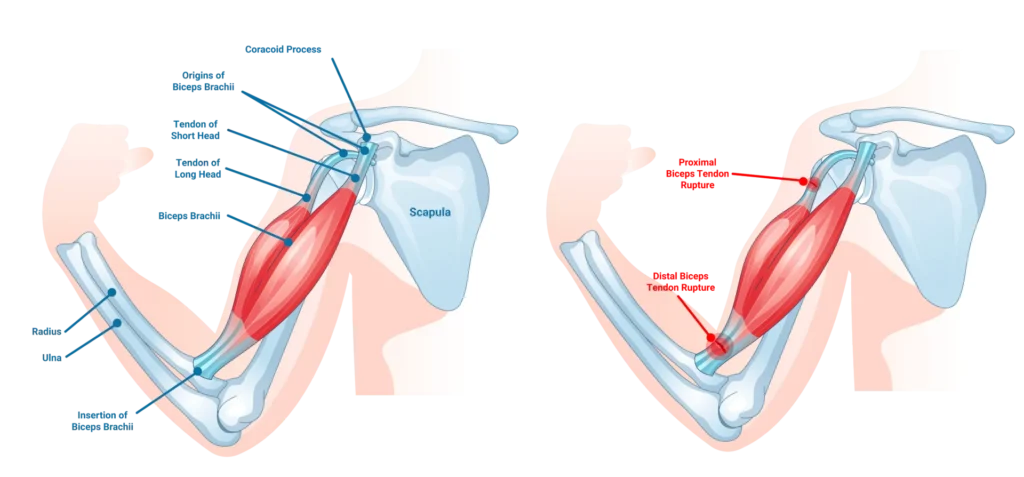
The biceps muscle runs down the front of the upper arm and has a tendon at each end. At the shoulder, there are actually two proximal tendons, the long head and the short head. The long head travels through the front of the shoulder joint in a groove on the humerus and attaches to the top of the glenoid labrum. Because of this intra-articular path, it’s exposed to the same wear as the rotator cuff and labrum, and it tends to degenerate before it tears.
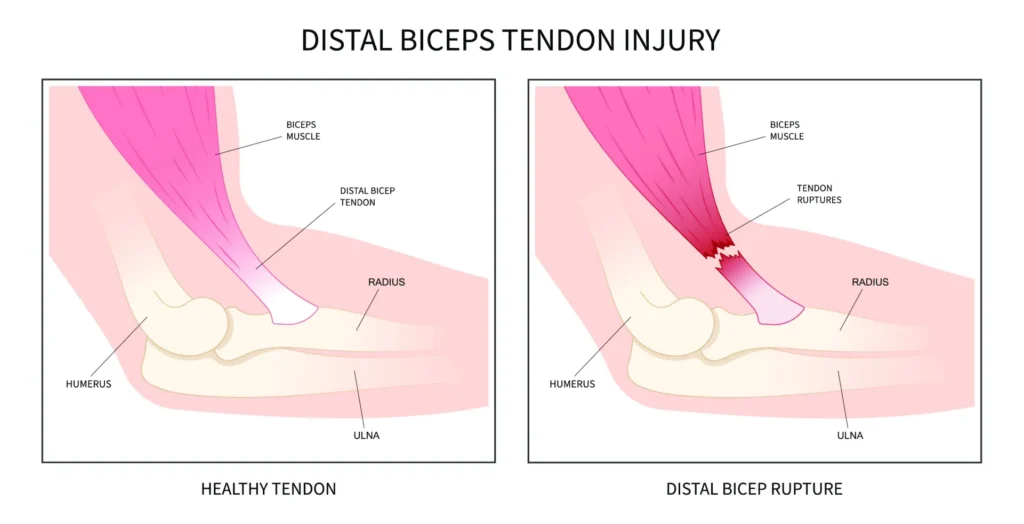
At the other end, the distal biceps tendon attaches to a bony prominence on the radius called the radial tuberosity. Its job there is more mechanical than the proximal tendon’s. It’s the primary driver of forearm supination (rotating the palm up) and contributes significantly to elbow flexion strength. When this tendon tears, the functional loss is real and measurable.
Understanding which end tore changes almost everything about the conversation that follows.
Proximal Biceps Tendon Tears (Near the Shoulder)
The long head of the biceps is the more commonly torn proximal tendon, and it rarely tears out of nowhere. In my experience, by the time it tears, it has usually been fraying, inflamed, or partially damaged for months or years. Patients often describe a history of aching at the front of the shoulder before the sudden pop that signals a complete rupture. The pain that precedes the tear sometimes actually gets better after the tendon finally lets go, as the source of the irritation is gone.
When the long head tears, the muscle belly slides down toward the elbow, creating a visible bulge in the lower arm sometimes called a Popeye deformity. It’s distinctive, and patients usually notice it immediately.
Who Can Observe and Who Should Consider Surgery
This is where I push back on a one-size-fits-all recommendation. For older patients and those whose primary concern is pain rather than strength or appearance, observation is a completely reasonable choice. The short head of the biceps is still intact, and most patients retain most of their elbow flexion strength. They’re not walking around with a significant functional deficit, just a cosmetically changed arm.
The patients I tend to have more active conversations about repair with are younger individuals, heavy laborers, competitive athletes, or anyone bothered enough by the Popeye deformity to want it corrected. In those cases, biceps tenodesis, releasing the torn tendon stump from its attachment and re-anchoring it in the bicipital groove outside the joint, is my preferred surgical approach. It decompresses the shoulder of an irritant, corrects the cosmetic deformity, and recovers the small amount of supination strength that gets lost when the long head tears.
The short head tendon rarely tears on its own and almost never requires surgery when it does.
Distal Biceps Tendon Tears (Near the Elbow)
Distal biceps tears are less common than proximal tears, but they tend to be more functionally significant. The classic story is an individual in their forties or fifties, often someone who lifts regularly, who loads the arm eccentrically: catching something heavy, a biceps curl with too much weight, resisting a sudden pull. There’s a sharp pain at the front of the elbow, sometimes an audible pop, followed by bruising that tracks down the forearm over the next day or two.
The exam findings are pretty reliable. There’s tenderness in the antecubital fossa, and on the hook test, where I ask the patient to actively flex the elbow to 90 degrees and I try to hook a finger under the biceps tendon on the lateral side, there’s nothing there to hook. MRI can confirm it.
Why I May Recommend Repair for Active Patients
With distal tears, my recommendation may be surgical repair in active patients, and I’m fairly direct about why: conservative management may not fully recover forearm supination strength. For a patient who uses their arm for work, athletics, or anything that involves rotating the forearm, that deficit may not go away with physical therapy.
The repair involves reattaching the tendon back to the radial tuberosity, typically through a single incision at the front of the elbow. When the repair is done within a few weeks of the injury, the tendon is still supple and mobile enough to reach its insertion without tension. Waiting lets the tendon retract and scar into the arm, which can make repair more difficult.
What I See in My Patients
The pattern I encounter most often with proximal tears: a patient who comes in having already noticed the Popeye sign, pain that’s actually improving, and a question about whether the arm is going to be “okay.” In most cases for those patients, the answer is yes. We watch it, manage any residual shoulder discomfort, and revisit surgery only if something changes about their goals or symptoms.
With distal tears, the pattern is different. The patient usually comes in within a week or two of injury because the functional loss is obvious: they can’t twist a jar lid, they feel weakness every time they reach for something.
My Approach to Treatment
For proximal tears, my default is a thoughtful conversation before any recommendation. I want to know what the patient does for work, what they do for exercise, whether the deformity bothers them, and what their pain level actually is. For a patient who rows or swims competitively, tenodesis is a reasonable conversation. For a patient whose main concern is whether the arm will hold up for gardening and grandchildren, observation usually wins. For distal tears in active patients, we have a similar conversation, but surgery may be more likely to be considered, and on a shorter timeline.
Regardless of which injury and which path, I want patients leaving my office understanding that this is their decision, not mine, but I’ll give them my honest read on what each choice actually means for their arm five and ten years from now. That’s what the conversation is for.
Summary
Biceps tendon tears are not one injury. Where the tendon tore, how completely it tore, and how quickly the patient gets in to see someone all shape what options are actually on the table. Proximal tears near the shoulder are common, often manageable without surgery, and rarely urgent. Distal tears near the elbow can be less forgiving.
If you felt or heard a pop in the front of your shoulder or elbow, especially with a sudden load on the arm, don’t wait to get it evaluated. The exam takes minutes and the imaging is straightforward. Request an appointment and we’ll figure out exactly what tore, what it means for your arm, and what your options look like.
Frequently Asked Questions
Can a biceps tendon tear heal on its own?
A complete tear does not reattach on its own. The question isn’t whether it heals; it’s whether the body compensates well enough without the tendon in place. For proximal long head tears, many patients function well without surgery. For complete distal tears, the functional deficit is significant enough that “healing” without repair really means learning to live with permanent weakness, not recovering the lost strength.
Is a biceps tendon tear the same as a rotator cuff tear?
No, though the two can coexist. The rotator cuff is a group of four separate muscles and their tendons that stabilize the shoulder joint and power rotation. The long head of the biceps runs through the shoulder joint alongside the rotator cuff and is frequently irritated by the same conditions, but it’s a distinct structure. When I see a proximal biceps tear on MRI, I’m always looking closely at the rotator cuff at the same time, because the two injuries often travel together.
Should I see a shoulder specialist or an elbow specialist for a biceps tear?
Ideally, someone who treats both, because the diagnosis often isn’t clear until you’ve been examined and imaged, and biceps tears at the shoulder can look clinically similar to other shoulder pathology. As a surgeon who specializes in both shoulder and elbow conditions, I can evaluate the full picture and make sure you’re not getting a shoulder workup when you actually have an elbow injury, or vice versa.
