


Medically reviewed by James Andry, MD | Reviewed July 2026
Almost every week, a patient sits in my San Diego office describing the same thing: pain when they lift their arm, worse at night, worse reaching overhead. The question I get asked most often after that description is whether they’re dealing with shoulder impingement vs. rotator cuff tear, and honestly, that’s a fair question to ask, because the two conditions can feel remarkably similar in the early stages. They’re also closely related anatomically, which doesn’t make things easier for a patient trying to sort out what’s actually going on in their own shoulder.
Key Takeaways
- Shoulder impingement and rotator cuff tears both cause pain with overhead motion, but they involve different degrees of tissue damage.
- Impingement is typically a compression problem, while a rotator cuff tear involves actual damage to the tendon fibers themselves.
- Diagnosis relies on a combination of physical exam findings and imaging, most often MRI or ultrasound.
- Treatment often starts conservatively for both conditions, with surgery reserved for cases that don’t respond or involve significant tearing.
Two Conditions, One Crowded Space
To understand shoulder impingement vs. rotator cuff tear, it helps to picture the anatomy involved. The rotator cuff tendons pass through a narrow channel beneath a bony arch called the acromion. This space, the subacromial space, is tight to begin with, and there isn’t much room to spare for swelling, bone spurs, or thickened tissue.
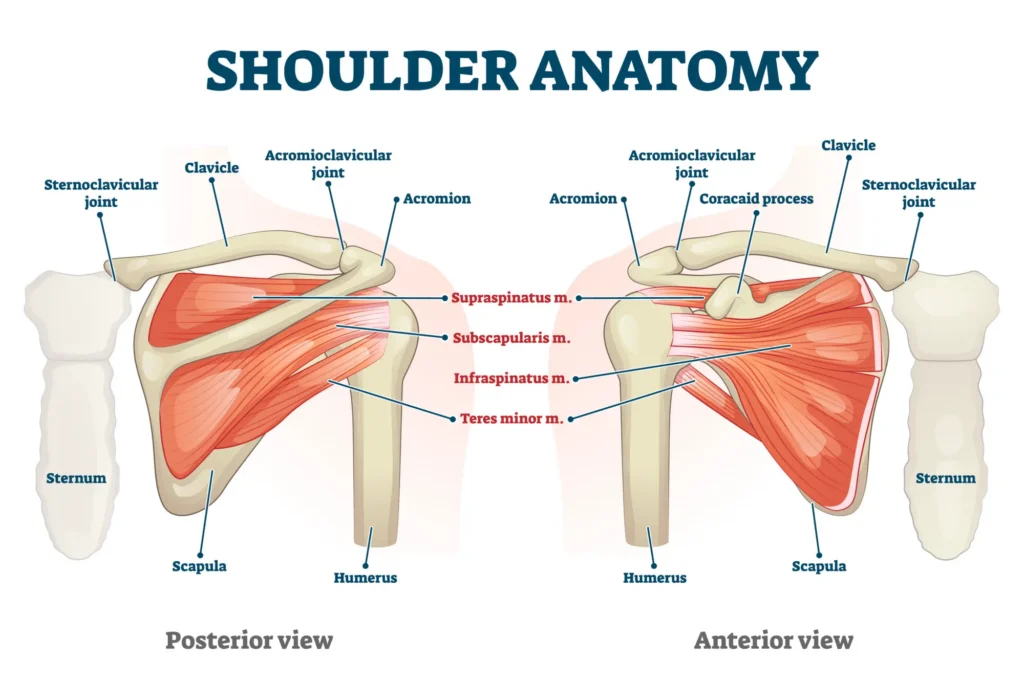
Impingement happens when something narrows that space further, pinching the rotator cuff tendons and the bursa that cushions them every time you lift your arm. A rotator cuff tear, on the other hand, means the tendon fibers themselves have been damaged, whether that’s a partial fraying or a complete separation from the bone. In many patients I see, these aren’t separate stories at all. Chronic impingement, left alone long enough, gradually wears down the tendon until a tear develops.
The subacromial bursa deserves a mention here too, since it often gets caught in the middle of this whole process. This small, fluid-filled sac sits directly above the rotator cuff tendons and beneath the acromion, cushioning the tendons as they glide during arm movement. When impingement develops, the bursa frequently becomes inflamed right alongside the tendons, which is part of why the pain from impingement and the pain from a mild rotator cuff injury can feel almost identical to the person experiencing it.
What Shoulder Impingement Feels Like
Patients with impingement tend to describe discomfort concentrated on the outer part of the shoulder, often worst somewhere in the middle of the arc when lifting the arm out to the side, roughly between 60 and 120 degrees. Lift the arm past that point, or keep it below the arc entirely, and the pain frequently eases.
The pain itself is usually described as an ache that sharpens with specific movements: reaching into a cabinet, putting on a jacket, or swimming freestyle. Night pain is common as well, particularly when lying on the affected side. Strength is generally preserved in classic impingement, which is one of the features that can help distinguish it from a tear.
What a Rotator Cuff Tear Feels Like
A rotator cuff tear shares a lot of overlap with impingement pain, which is exactly why the distinction can be tricky without an exam. Pain with overhead activity and at night are both common to both conditions. Where a tear tends to differ is in the weakness department.
Patients with a meaningful rotator cuff tear frequently struggle to lift the arm against resistance, or notice that once the arm is raised, it feels unstable or wants to drop. Some describe a grinding or catching sensation. A traumatic tear, from a fall or a sudden heavy lift, tends to bring on sharp, immediate pain and weakness, while a degenerative tear that’s built up gradually over months or years may announce itself more subtly, sometimes only becoming obvious once a particular movement finally becomes too painful or too weak to perform.
Why the Two Conditions Get Confused
The rotator cuff tendons and the subacromial space are so closely linked that inflammation in one area frequently affects the other. Bursitis, tendinitis from impingement, and partial tearing often coexist on the same MRI. Add in the fact that both conditions cause pain in a similar location and worsen with similar movements, and it becomes clear why a hands-on evaluation matters more than a self-diagnosis based on symptoms alone.
I tell patients that the arc of pain and the presence or absence of true weakness are usually my two biggest clues on exam, though neither is perfectly reliable by itself. Some patients with significant tears retain surprising strength, particularly if the tear is small or if surrounding muscles compensate.
Who Tends to Develop Each Condition
Impingement shows up frequently in people whose daily routines involve repetitive overhead motion. Swimmers, painters, and anyone working construction or warehouse jobs that involve reaching above shoulder height regularly fall into this category. Age plays a role too. As the acromion bone changes shape over the decades, sometimes developing a small hook or spur, the subacromial space can narrow further, increasing impingement risk even in people without an obviously repetitive job or hobby.
Rotator cuff tears follow a somewhat similar pattern but skew toward an older population overall, since tendon quality naturally declines with age regardless of activity level. That said, younger athletes aren’t immune. A single forceful injury, like a hard fall while surfing or a tackle on the football field, can tear a healthy young tendon just as effectively as decades of gradual wear can tear an older one.
Family history and prior shoulder injuries also appear to raise risk for both conditions, though the research connecting genetics specifically to tendon degeneration is still evolving.
How We Tell Them Apart
Diagnosis starts with a detailed history: when the pain began, whether there was a specific injury, and which activities provoke symptoms. The physical exam includes strength testing for each of the four rotator cuff muscles individually, along with specific maneuvers designed to reproduce impingement pain.
Imaging adds clarity beyond what the exam alone can determine. Ultrasound offers a dynamic, real-time look at the tendons as the shoulder moves, which I find genuinely useful for distinguishing bursitis from a structural tear. MRI provides the most detailed view of the soft tissues and remains the gold standard when surgery might be on the table, since it shows tear size, tendon retraction, and muscle quality with a level of detail ultrasound can’t quite match.
What I See in My Patients
A pattern I notice constantly in my San Diego practice is how many active adults wait months before coming in, assuming their shoulder will simply work itself out. Sometimes it does. More often, especially with impingement, the shoulder needs a nudge in the right direction before it improves on its own.
I’ll say this plainly: I think a lot of people wait too long to get a mechanical shoulder problem looked at, and it’s usually not because the pain wasn’t bad enough to matter, but because they assumed it would behave like a typical muscle strain and fade on its own timeline. Impingement and rotator cuff tears don’t always follow that pattern, and delaying evaluation sometimes means a tendon that could have responded well to therapy has progressed further than it needed to.
My Approach to Treatment
For most patients presenting with impingement, I start with a conservative plan: physical therapy focused on scapular mechanics and posture, activity modification to reduce the aggravating overhead motions, and anti-inflammatory medication when appropriate. If that combination isn’t enough, I may consider adding a corticosteroid injection to calm things down enough for therapy to actually gain traction.
Small, partial rotator cuff tears in patients without high physical demands often do reasonably well with the same conservative approach used for impingement. Larger or full-thickness tears, especially in younger or more active patients, are a different situation, and I’m generally more direct about recommending arthroscopic repair in that group, because tendon quality tends to decline the longer a significant tear goes unaddressed.
When surgery is the right call, I use arthroscopic techniques for the vast majority of both impingement decompression and rotator cuff repair, working through small incisions with a camera to relieve pressure on the tendons or reattach torn tissue to the bone.
You can read more about the anatomy and range of conditions I treat on our shoulder disorders page, and more specifically about where rotator cuff pain tends to show up if that’s the piece of this puzzle you’re trying to sort out.
Summary
Shoulder impingement and rotator cuff tears often cause similar symptoms, but they are different conditions that require different treatment approaches. A thorough physical exam and appropriate imaging help distinguish between them, allowing treatment to begin with conservative care in most cases while identifying patients who may benefit from surgery.
If you’re dealing with shoulder pain that fits somewhere in this picture, whether it leans more toward classic impingement or feels like there’s real weakness involved, the most useful next step is a hands-on exam rather than more guesswork from home. Schedule a visit through our appointment page, and we’ll sort out exactly which structures are involved and build a treatment plan around your specific shoulder and activity level.
Frequently Asked Questions
Can shoulder impingement turn into a rotator cuff tear?
Yes, this is a potential progression. Ongoing compression and inflammation from untreated impingement can gradually wear down the tendon fibers, eventually leading to fraying or a partial tear if the underlying mechanical problem isn’t addressed.
How can I tell if I have impingement or a torn rotator cuff without an MRI?
It’s difficult to be certain without a professional evaluation, since the two conditions share many symptoms. Significant weakness when lifting the arm against resistance is more suggestive of a tear, but a physical exam by an experienced orthopedic specialist is the most reliable way to distinguish between them.
Do I need surgery for shoulder impingement?
Many cases of impingement improve with physical therapy, activity changes, and sometimes an injection. Surgery is typically reserved for patients who don’t improve after a genuine trial of conservative treatment.
Is rotator cuff surgery always necessary for a tear?
No. Many partial tears, and even some smaller full-thickness tears in lower-demand patients, can be managed successfully without surgery. The decision depends on tear size, symptoms, activity level, and how the shoulder responds to initial conservative treatment.
