

Medically reviewed by James Andry, MD | Reviewed July 2026
I see a shoulder labral tear in my San Diego clinic almost every week, and it comes from a variety of causes. One patient may be a weekend surfer who felt something shift after a hard fall off the board. Another, a former college pitcher whose shoulder has ached for years without a single dramatic injury. A shoulder labral tear can develop suddenly or creep in slowly, and figuring out which type you have, and how much it’s actually affecting your shoulder, is the first real step toward feeling better.
Key Takeaways
- A shoulder labral tear involves the ring of cartilage that deepens your shoulder socket, and it can range from minor fraying to a full detachment.
- Tears fall into a few distinct categories, including SLAP tears at the top of the labrum and Bankart tears at the front, each with a slightly different cause and treatment path.
- Diagnosis usually combines a physical exam with imaging, most often an MRI or MR arthrogram.
- Many labral tears respond to physical therapy and activity changes, though some patients do better with arthroscopic repair.
What Is a Shoulder Labral Tear?
The labrum is a rim of tough, fibrous cartilage that lines the socket of your shoulder joint, called the glenoid. Because the glenoid is shallow compared to the size of the humeral head, the labrum plays an outsized role in keeping the joint stable. It deepens the socket, provides an attachment point for several key ligaments, and anchors the long head of the biceps tendon at the top of the shoulder.
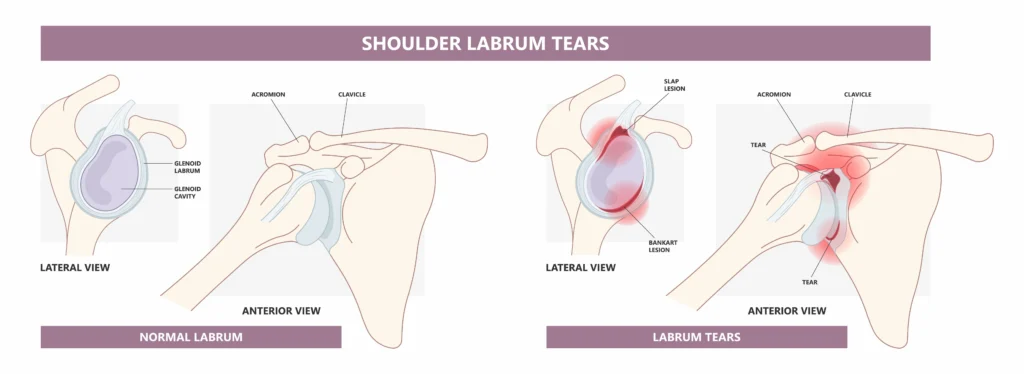
When part of this cartilage tears away from the bone, the shoulder can lose some of that stability. Depending on where the tear occurs and how large it is, patients notice anything from a vague ache to a genuine feeling that the joint is going to slip out of place.
Types of Labral Tears
Not all labral tears are the same injury, and the distinction matters for treatment.
A SLAP tear affects the superior, or top, portion of the labrum, right where the biceps tendon attaches. A Bankart tear involves the front-lower portion of the labrum and is the injury most often responsible for a shoulder that has dislocated. Posterior labral tears, which occur at the back of the socket, are less common but sometimes show up in athletes who push or block repeatedly, like offensive linemen.
What Causes a Shoulder Labral Tear
Most tears come from one of two patterns. The first is a single traumatic event: a fall onto an outstretched arm, a shoulder dislocation, or a hard tackle. The second is repetitive stress, which builds up gradually in overhead athletes such as swimmers, volleyball players, and throwers. Aging plays a role too, since the labrum naturally loses some of its resilience over the decades, making it more prone to fraying even without a specific incident.
Occupation matters as well. Patients who spend their workday reaching overhead, whether they’re stocking shelves, working construction, or lifting patients in a hospital setting, tend to show up in my office with the same repetitive-stress pattern I see in overhead athletes.
Recognizing the Symptoms
Patients describe labral tear symptoms differently depending on the type and severity of the injury. Deep shoulder pain, especially with overhead motion, is common. So is a catching or clicking sensation during certain movements. Some patients also notice a sense that the shoulder feels loose or unreliable during activity, which is more typical of tears associated with instability, such as Bankart lesions.
Pain location can offer a clue, though not a definitive one. Tears near the biceps attachment tend to cause discomfort at the front and top of the shoulder that worsens with lifting or reaching overhead. Posterior tears more often produce a deeper ache toward the back of the joint, particularly during pushing motions.
How Labral Tears Are Diagnosed
Diagnosis starts with a conversation and a physical exam. I ask about the mechanism of injury, whether there was a specific event or a gradual onset, and which activities provoke symptoms. Specialized exam maneuvers can help narrow down whether the labrum, rather than the rotator cuff or another structure, is the primary source of pain.
Imaging confirms what the exam suggests. A standard MRI can often show labral pathology, though an MR arthrogram, where contrast dye is injected into the joint before the scan, tends to give a clearer picture of smaller or more subtle tears. X-rays are sometimes added to rule out bone involvement, particularly after a dislocation. When the exam and history point strongly toward a labral tear, I’d rather order the arthrogram up front than send a patient through a standard MRI that may miss a subtle tear and delay an accurate diagnosis.
What I See in My Patients
In my practice, the labral tears that surprise people the most aren’t the dramatic dislocations. Those patients usually know something is wrong immediately. It’s the slow-burn cases, the paddlers and swimmers up and down our San Diego coastline who’ve had a dull, nagging shoulder ache for a year and assumed it was just part of getting older, that catch people off guard when the MRI comes back showing a real tear.
Not every labral tear needs surgery, and I think that gets lost in a lot of the information out there. A fair number of the tears I see, particularly smaller SLAP tears without instability, do well with a structured therapy program aimed at strengthening the muscles around the shoulder blade. Where I do lean toward surgery more readily is with Bankart tears in younger, active patients, because the data on recurrent dislocation risk in that group is hard to ignore.
My Approach to Treatment
I typically start conservative unless there’s a clear reason not to. That usually means several weeks of physical therapy focused on rotator cuff and scapular strengthening, sometimes paired with activity modification to reduce the movements that provoke symptoms. For patients whose pain is more inflammatory than mechanical, I’ll occasionally add a corticosteroid injection to help them tolerate therapy. In some cases, platelet-rich plasma therapy may also be considered.
When a tear doesn’t respond to that approach, or when the pattern of injury points toward ongoing instability, I discuss arthroscopic repair. This is a minimally invasive procedure where I use small incisions and a camera to reattach the torn labral tissue to the bone with sutures. For patients with more complex tears or biceps tendon involvement, I sometimes recommend biceps tenodesis as part of the same procedure, and I walk through why in the specific context of their imaging and exam findings.
Recovery after labral repair is gradual and depends heavily on the type of tear addressed and the demands of the patient’s sport or job. I go over the general phases with every surgical patient in detail during their consultation, since the timeline for a recreational patient returning to daily activities looks different from a competitive overhead athlete working back toward their sport.
Shoulder disorders like labral tears often overlap with instability, and I’ve written more broadly about that topic on our page covering shoulder instability symptoms, which may be useful if your shoulder feels loose in addition to painful.
Summary
A shoulder labral tear is a common cause of shoulder pain, clicking, and instability, but not every tear requires surgery. An accurate diagnosis through a careful physical exam and appropriate imaging helps determine the type of tear and the best treatment, which regularly begins with physical therapy and progresses to arthroscopic repair only when necessary.
If your shoulder has been catching, aching deep inside the joint, or feels like it’s not entirely trustworthy during activity, the right next step is an evaluation, not more guessing. Book a visit through our appointment page so we can get a clear picture of what’s actually happening in your shoulder and build a plan around it, whether that ends up being therapy, an injection, or a conversation about surgery.
Frequently Asked Questions
Can a shoulder labral tear heal on its own?
Small tears, particularly fraying without instability, can sometimes improve with rest and a dedicated physical therapy program that strengthens the surrounding muscles. Larger tears or those associated with instability are less likely to resolve without more targeted treatment.
How serious is a labral tear in the shoulder?
Severity varies widely. Some tears cause minor, intermittent discomfort, while others lead to significant instability and repeated dislocations. An evaluation with imaging is the most reliable way to understand where your specific tear falls on that spectrum.
Do all labral tears require surgery?
No. Many patients, especially those with smaller SLAP tears and no instability, improve with physical therapy alone. Surgery tends to be considered when conservative treatment fails or when instability is a significant factor.
What does labral tear pain feel like?
Most patients describe a deep ache inside the shoulder joint, sometimes with catching, popping, or clicking during certain movements. Some also notice discomfort specifically with overhead activity.
How long is recovery after labral repair surgery?
Recovery timelines vary based on the type and location of the tear repaired, along with individual healing and rehabilitation progress. Your surgeon can give you a more specific timeline once your particular repair and recovery plan are established.
