


Medically reviewed by James Andry, MD | Reviewed May 2026
When a patient walks into my San Diego office after their second or third shoulder dislocation, the conversation usually shifts pretty quickly. The first dislocation feels like bad luck. By the second, they already know something’s wrong with the structure of the joint, not just the muscle around it. That structural problem almost always involves the labrum, and a common fix is a procedure called a Bankart repair. So, what is a Bankart repair and who needs it?
I perform this surgery often enough that I think a lot about who genuinely benefits from it and who doesn’t. There’s a real cost-benefit decision here, and I want patients to understand the trade-offs. This post walks through what a Bankart repair is, who I think is a strong candidate, and how I approach the procedure and recovery in my own practice.
Key Takeaways
- A Bankart repair is a surgical procedure that reattaches the torn labrum to the front of the shoulder socket after a dislocation, restoring the joint’s natural anchor.
- The procedure is most often recommended for patients who have had recurrent dislocations, younger active patients after a first dislocation, and athletes whose sports demand overhead or contact loading.
- Most Bankart repairs today are done arthroscopically through small incisions, with a recovery timeline measured in months.
What a Bankart Lesion Actually Is
The shoulder is a ball-and-socket joint, but calling it a socket overstates how much containment the bone provides. The glenoid (the socket side) is more like a shallow dish than a cup. What keeps the ball of the humerus centered is a rim of fibrous cartilage around the edge of the glenoid called the labrum, along with the ligaments and capsule attached to it.
When the shoulder dislocates anteriorly (forward, which is the direction more than 95% of dislocations go), the humeral head tears the labrum off the front of the socket on its way out. That detachment is a Bankart lesion. Until it heals back in the right place, the front of the socket has lost its anchor, and the shoulder is mechanically primed to dislocate again.
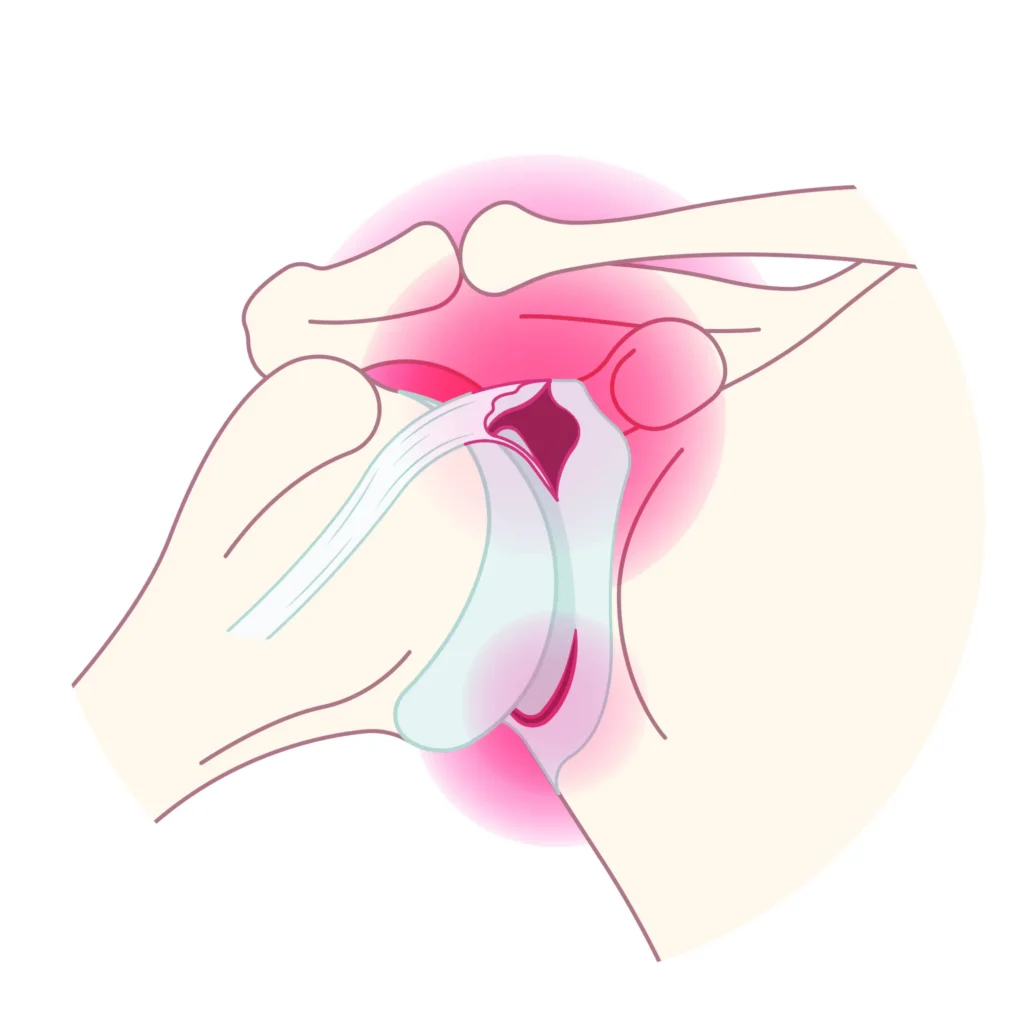
The lesion is named for Arthur Bankart, the British surgeon who first described it and the operation to fix it in the 1920s. The repair has changed enormously since then (we now do it through small incisions rather than one large open cut) but the principle is the same: take the detached labrum, place it back where it belongs on the rim of the glenoid, and anchor it down so it heals there.
Who Tends to End Up With One
A few patterns show up in my clinic over and over:
Younger patients after a first traumatic dislocation. Age matters here in a way that surprises people. A 19-year-old who dislocates a shoulder has around a 70 to 90% chance of dislocating it again. A 50-year-old’s odds are much lower. The younger the patient, the more aggressive I tend to be about discussing surgical stabilization early, because waiting for the second or third dislocation often means more cumulative damage to the socket.
Athletes in contact and overhead sports. Football players, hockey players, surfers, volleyball players, rock climbers. Anyone whose sport puts the arm in the abducted, externally rotated position under load has a higher risk of traumatic dislocation. Here in San Diego, where we have a very active population, we see a lot of these.
Patients with recurrent instability. If you’ve had two or more dislocations, the labrum is almost certainly not going to heal on its own, and each subsequent dislocation tends to do a little more damage. At some point the math stops favoring conservative care.
Causes and Mechanisms
Most Bankart lesions are traumatic. Think a fall on an outstretched arm, a tackle, a wave that catches a surfer’s arm at the wrong angle, or a wrestling takedown. The arm gets forced into a position the joint can’t tolerate, the humeral head pops forward, and the labrum tears off the front of the socket on the way.
A smaller subset of patients develop labral injury more gradually, through repetitive microtrauma. Throwing athletes are the classic example. The cumulative stress of thousands of pitches or serves can stretch and eventually tear the labrum even without a discrete dislocation event. (A related but distinct injury, a SLAP tear, affects the upper portion of the labrum rather than the front, and gets a different repair.)
There’s also a bony version of this injury (a bony Bankart) where a piece of the glenoid actually breaks off with the labrum. When that fragment is large enough, the calculus changes, and a standard soft-tissue repair may not be enough. That’s a decision I make based on a CT scan and the amount of bone loss.
How to Tell If You Need One
The symptoms are pretty consistent: a shoulder that has dislocated at least once, an ongoing sense that the joint is going to slip out again, and apprehension when the arm is raised and rotated outward. Patients often describe avoiding certain movements without consciously deciding to. Reaching back to grab something from the back seat. Putting on a jacket. Throwing a ball overhand. That avoidance is your shoulder telling you it doesn’t trust itself.
On the clinical side, I rely on a focused physical exam (the apprehension and relocation tests, mostly) and imaging. An MRI with contrast is my workhorse for seeing the labrum clearly. If there’s any suggestion of bone loss on the X-ray, I’ll add a CT.
The diagnostic question I’m really trying to answer in the office is not just “is the labrum torn” but “is this shoulder going to keep dislocating if we don’t fix it.” Those are different questions, and the answer drives the recommendation.
My Approach to Treatment
My default for Bankart repairs is arthroscopic. Through small portals, I can see the labrum directly, prepare the bone surface so the tissue has something to heal to, and use suture anchors to fix the labrum back onto the rim of the glenoid. Open repair is still occasionally the right answer, usually when there’s significant bone loss, when an arthroscopic repair has already failed, or when there’s an associated injury that’s easier to handle openly, but for most first-time stabilizations, arthroscopic gives equally durable results with less surrounding tissue trauma.
I don’t think every first dislocation needs surgery, and I don’t think every patient should wait for a second dislocation either. The decision turns on age, activity level, the imaging, and what the patient actually wants their shoulder to do for the next forty years. A college lacrosse player and a 55-year-old recreational golfer don’t get the same recommendation, even with the same lesion on the MRI.
Recovery, in my experience, is where most patients underestimate the commitment. I tell patients to plan on six months before they’re back to contact sports and closer to a year before the shoulder fully feels like theirs again.
What I See in My Patients After Surgery
Something I see and want to flag for anyone considering this surgery: the shoulder tends to feel better well before it is better. By eight or ten weeks, most of my patients are out of pain, off the sling, and starting to feel like themselves. They want to start lifting, throwing, surfing. The healing biology underneath may not be ready for that, even when the body feels ready.
The patients who reinjure their repair are almost never the ones at six weeks. They’re the ones at four or five months who started feeling great and quietly pushed past the protocol.
The flip side: the patients who follow the program typically experienced improved shoulder function. Surfing, climbing, throwing, lifting — the activities that brought them in get returned to them. That’s the case for the surgery when the indication is right.
Summary
If you’ve dislocated your shoulder more than once, or you’re a young or athletic patient after a first dislocation, a Bankart repair is worth a conversation. The procedure itself is well-established and almost always arthroscopic now. The hard parts are the recovery and the discipline it requires, not the surgery.
If your shoulder has dislocated and you haven’t had it formally evaluated, that’s the next step. Get the imaging first, then the conversation about what to do with it. Schedule an appointment and we’ll figure out whether you’re a candidate or whether your shoulder is one of the ones we can manage without operating.
Frequently Asked Questions
Will I ever be able to return to contact sports?
For many patients, yes. The general benchmark is six months for return to contact and overhead sports, assuming the repair has healed and strength and motion are restored. Some patients take longer, especially if there was associated bone loss or if rehab progress is slower than expected.
What happens if I don’t have the surgery?
Living with recurrent instability is a real option, and some patients choose it. The trade-off is that each subsequent dislocation tends to cause more damage to the labrum, the surrounding cartilage, and sometimes the bone of the glenoid. That makes a future repair more complicated and the long-term outcome less predictable. The earlier the conversation happens, the more options are usually on the table.
Are there alternatives to a Bankart repair?
For patients with significant bone loss on the front of the glenoid, a soft-tissue Bankart repair alone may not be enough. In those cases, a Latarjet procedure, which transfers a piece of bone from the coracoid to rebuild the front of the socket, is sometimes the better choice. I make that call based on imaging, and it’s something I’d discuss directly with any patient where bone loss is in the picture.
