


Medically reviewed by James Andry, MD | Reviewed June 2026
“How long does frozen shoulder last?” If you’re dealing with it, that question is probably on your mind every day. Frozen shoulder can make even simple tasks feel challenging. Reaching overhead, fastening a seatbelt, or putting on a jacket may suddenly become painful and difficult. Most patients want to know what to expect and when they can start feeling like themselves again.
Frozen shoulder, clinically known as adhesive capsulitis, can last anywhere from one to three years, and in some cases longer without the right treatment. That range is frustrating to hear, I know. But the condition is well understood, and there are options at every stage to reduce pain, preserve motion, and shorten the overall course.
In this post, I’ll walk through what drives that timeline, what each phase of frozen shoulder actually feels like, and what tends to move things forward faster.
Key Takeaways
- Frozen shoulder typically lasts one to three years, though timelines vary significantly from person to person.
- The condition progresses through three overlapping stages: freezing, frozen, and thawing, each with different symptoms and treatment priorities.
- Early treatment (physical therapy, injections, and activity modification) may help manage pain and may reduce the overall duration.
- For patients whose motion stays severely limited despite conservative care, manipulation under anesthesia or arthroscopic capsular release may be considered.
What Frozen Shoulder Actually Is
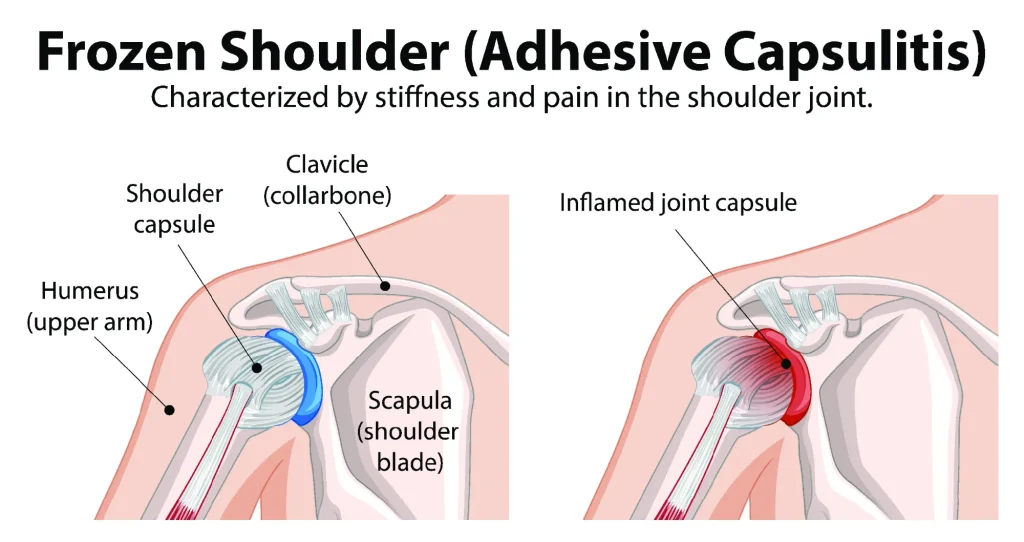
The shoulder is surrounded by a flexible joint capsule, a sleeve of connective tissue that normally allows the arm to move freely in all directions. In frozen shoulder, that capsule becomes inflamed, thickened, and tight. Scar tissue called adhesions forms within the capsule’s folds, restricting movement. The joint also loses synovial fluid that normally lubricates it, which compounds the stiffness.
That scar tissue formed as part of an inflammatory response, and it takes real time to loosen and remodel. That’s the core reason this condition doesn’t clear up in a few weeks the way a simple sprain might. Frozen shoulder can develop on its own for no clear reason (primary or idiopathic frozen shoulder), or it can follow immobilization after injury or surgery (secondary frozen shoulder). My earlier post on what causes frozen shoulder goes deeper into the underlying mechanisms.
The Three Stages and Their Timelines
Frozen shoulder moves through three distinct stages. Knowing where you are shapes both expectations and treatment.
Stage 1: The Freezing Phase
This is usually the most painful stretch. The shoulder aches constantly, worsens at night, and hurts with even small movements. Motion starts to decrease, slowly, then more noticeably. Patients often describe feeling like they can’t get comfortable in any position. The freezing phase can last anywhere from six weeks to nine months, though some patients move through it faster or slower. Pain management and protecting whatever range of motion remains are the priorities during this stage.
Stage 2: The Frozen Phase
The intense pain from Stage 1 often begins to ease, but stiffness becomes the dominant problem. Dressing, fastening a seatbelt, reaching into a back pocket — all of these become difficult. Functional limitation is usually at its worst here. This phase tends to last four to six months on average, though it can stretch longer.
Stage 3: The Thawing Phase
Motion gradually returns (though not always evenly, and not always at a predictable pace). Some patients improve steadily; others plateau for weeks, then make a sudden jump. Physical therapy plays a central role here, guiding the shoulder through progressively greater ranges of motion as the capsule loosens.
The thawing phase can last anywhere from five months to two or more years, depending on severity and how well the shoulder responds to treatment. This is also where proactive intervention (when indicated) may help accelerate recovery for patients who haven’t made adequate progress through the earlier stages.
What I See in My Patients
In my practice, I see a wide spectrum of presentations. Some patients arrive in the early freezing phase. Others come in months later, already deep in the frozen phase, looking for something more effective than “just wait it out.”
Living in San Diego, I see a specific subset who are especially motivated to recover, including surfers, beach volleyball players, paddleboarders, and older athletes who simply won’t accept two years of limited use. Honestly, I think the passive “wait and see” approach is rarely right for anyone. Active management almost always produces better outcomes than watching the clock.
What I’ve observed is that patients who get appropriate treatment early, especially before the stiffness becomes severe, tend to move through the stages faster and with less functional loss overall. The patients who struggle most are those who delayed care, sometimes because they were told the condition would resolve on its own. That can be true. But “it might go away eventually” isn’t the same as “we can’t help you get there faster.”
Frozen shoulder also disproportionately affects patients between 40 and 60 years old, and underlying conditions (particularly diabetes) may worsen both severity and duration. I factor that into the treatment plan from the very beginning.
My Approach to Treatment
The philosophy is simple: match the intervention to the stage, and don’t default to watchful waiting when we have tools that can help.
In the freezing phase, pain control comes first. I may use corticosteroid injections to reduce the inflammation driving symptoms, paired with physical therapy to keep the shoulder moving. Anti-inflammatory medications can also help. The goal at this stage isn’t to push through stiffness; it’s to manage pain well enough that the patient can actually engage with therapy and avoid guarding the shoulder into further tightness.
In the frozen phase, the focus shifts to restoring mobility. Therapy continues, emphasizing gentle stretching and range-of-motion work. If progress stalls despite consistent treatment, that’s when I have a direct conversation about more interventional options. For patients not responding to conservative care, manipulation under anesthesia (MUA) or arthroscopic capsular release may be appropriate.
In the thawing phase, I’m mostly guiding rehabilitation and monitoring progress. This phase rewards consistency more than intensity. My shoulder rehab protocols offer additional context on how structured rehabilitation typically unfolds.
I also want to make sure we’re treating the whole picture. If a patient has uncontrolled diabetes or a thyroid issue that’s contributing to the condition, addressing that with their primary care physician is part of the plan, not an afterthought.
What Affects How Long It Lasts
No two cases follow the same path. A few factors consistently influence whether the condition runs a shorter or longer course:
- Underlying health conditions: Diabetes, thyroid disease, and similar systemic conditions tend to prolong the course and make the shoulder more resistant to treatment.
- Timing of treatment: Earlier intervention generally correlates with shorter duration and less functional loss. Waiting months to seek care often means a longer road back.
- Consistency with physical therapy: Patients who stick with guided stretching and range-of-motion work tend to recover more efficiently than those who approach it intermittently.
- Primary vs. secondary frozen shoulder: Secondary frozen shoulder (following surgery or injury) can sometimes be more resistant depending on what triggered it.
Summary
Frozen shoulder is a difficult condition, physically and emotionally. Months of pain and limited motion wear on people. The answer to “How long does frozen shoulder last?” isn’t a simple number, but what I can say with confidence is this: most patients recover. The right treatment shortens the course and reduces the suffering. Don’t treat it like something you simply have to endure.
The biggest mistake I see is patients who wait a year or more before getting a proper evaluation, often because they were told frozen shoulder always resolves on its own. Sometimes it does. But waiting it out is a long time to live with a shoulder you can barely use. Early diagnosis and stage-appropriate treatment make a real difference in how this goes.
If you’re in the San Diego area and your shoulder has been stiff or painful for more than a few weeks, come in for an evaluation. A targeted exam and imaging can tell us where you are in the process and what approach makes the most sense for you. Schedule a consultation here and let’s get the conversation started.
Frequently Asked Questions
How long does frozen shoulder last without treatment?
Without treatment, frozen shoulder may still resolve on its own, but the process can take two to three years or longer, and some research suggests a small percentage of patients experience residual stiffness even beyond that. Early treatment doesn’t guarantee a faster resolution, but it reliably reduces pain, and consistent intervention may help prevent the condition from reaching its most severe stage of stiffness.
Can frozen shoulder come back after it resolves?
Recurrence in the same shoulder is uncommon once it’s fully resolved. Frozen shoulder can, however, develop in the opposite shoulder — research suggests this happens in a meaningful percentage of patients, sometimes years later. If you’ve had it on one side, it’s worth watching the other for early signs of stiffness.
Can physical therapy make frozen shoulder worse?
Physical therapy should not make frozen shoulder worse when it’s tailored to the stage of the condition. During the painful freezing phase, overly aggressive stretching can sometimes increase irritation and discomfort. The goal is to maintain as much motion as possible while controlling pain. As the shoulder progresses into the frozen and thawing phases, therapy typically becomes more focused on gradually restoring range of motion and function.
When should I see a doctor for frozen shoulder?
If shoulder pain and stiffness have persisted for more than a few weeks, or if you’re steadily losing range of motion, it may be worth scheduling an evaluation. Frozen shoulder is often easier to manage when treatment begins early, before severe stiffness develops. An experienced shoulder specialist can also rule out other causes of shoulder pain, such as a rotator cuff tear, arthritis, or a labral injury, which can sometimes mimic frozen shoulder symptoms.
